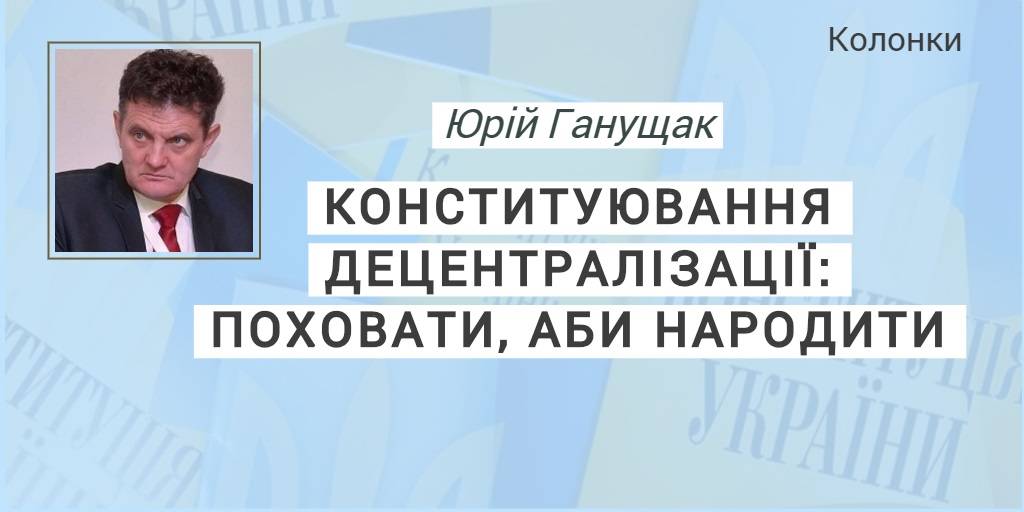
Enshrining decentralisation in the Constitution: bury to give birth
By Yuriy Hanushchak, Director of the Territory Development Institute, for ZN.UA
At the Local Self-Government Forum on 5 December 2018, the Prime Minister of Ukraine stressed the need to amend the Constitution to enshrine achievements of power decentralisation.
Failure to do so will endanger the imperceptible but systematic de facto wind-up of the reform by introducing changes to the laws and acts of the Government, as it was during Yanukovych’s time.
The presidential draft law (No. 2217-a), approved in the first reading, seems outdated after three years of actual implementation of decentralisation.
Insofar, there was a need to submit a new draft law with amendments to the Constitution, moreover, with no delay. Because the new parliamentary structure will most likely not give the required 300 votes for its final approval.
Of course, the new draft amendments to the Constitution should address the main tasks envisaged by the draft law No.2217-a, namely the creation of a three-tier system of administrative-territorial structure, delimitation of competences of the executive authorities and local self-government bodies at the subregional and regional levels, balance of LSG resources in accordance with the powers transferred to LSG bodies.
Сanonically pure amending of the Constitution has the following form: by the end of the current session, the Parliament will vote for the draft law No. 2217-a, failing it of course. At the beginning of the new session, the President presents new draft amendments to the Constitution, under a new name, emphasising not only decentralisation, but also the overall reform of the territorial organisation of power. After approval of the document by the Parliament, preferably until March 31, which is quite expected (since the failure to implement the decentralisation reform is not openly voiced by any political force at the moment), it will be submitted to the Constitutional Court. And already in early autumn the Parliament most probably will vote for its approval as a whole.
Whether such a technology will work or not depends on the head of state and the level of maturity of the political elite. The next chance to finally break away from the Soviet past, based on traditional political cycles, will appear not earlier than ten years later. In times of acceleration of globalisation and challenges, associated with it, this timeframe seems to be eternity.
The full version is available HERE

10 July 2026
Безпечна вода під час війни: результати...
Пошкодження водогонів, тривалі перебої з водопостачанням, використання криниць та альтернативних джерел води стали...
10 July 2026
Українська урбаністична платформа розпочала всеукраїнське дослідження урбаністичного сектору
Українська урбаністична платформа розпочала...
Громадська організація «Українська урбаністична платформа» розпочинає всеукраїнське опитування професійної спільноти:...
09 July 2026
Кафедра регіональної політики КНУ імені Тараса...
Кафедра регіональної політики КНУ імені Тараса Шевченка запрошує на магістерські програми для фахівців, які працюють...
09 July 2026
Не одна модель: як українські громади переосмислюють громадську участь під час війни
Не одна модель: як українські громади...
Повномасштабна війна не лише змінила форми громадської участі а й продемонструвала, що в різних умовах виникають...