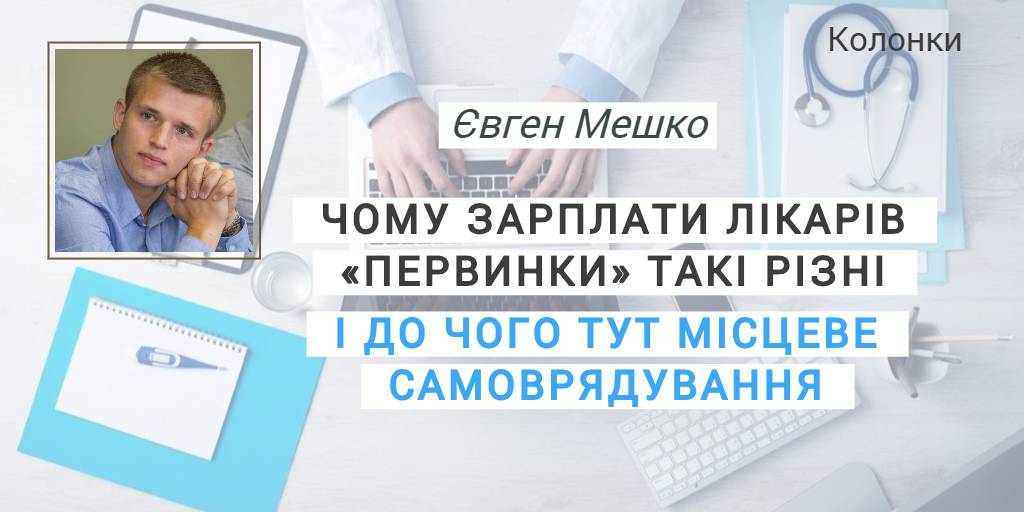
Why do “primary” doctors’ salaries differ so much, and how does local self-government come into the picture?
By Yevhen Meshko, chief doctor of the Communal Non-Profit Enterprise “Primary Healthcare Centre of Mukachevo”,
regional coordinator of the U-LEAD with Europe Programme for healthcare reform support in the Zakarpattia Oblast
With the transition to the capitation system of primary healthcare financing and autonomisation of healthcare institutions providing primary healthcare services, I hear a radically different views of healthcare workers. Some of them admit fantastic changes, someone is sure that nothing has changed in terms of remuneration. There are even isolated cases of claiming that the situation has become worse compared to targeted subventions.
So what affects salaries?
I want to distinguish two concepts – financing and payment. Financing is about where from and how much money to get, how to increase money inflow. Payment is how we spend this money: what for and in what amount, etc.
Funding is roughly the same in all medical institutions, but the payment options vary greatly. The leadership of primary healthcare establishments plays an integral role in this process.
Why, with relatively homogeneous wage funds (since they fluctuate within 70-100% of revenues), does the average salary in different institutions range from UAH 5 to 25 thousand? To do this, I would introduce another coefficient – the ratio of doctors’ posts to other medical staff. Why doctor’s posts? These are the employees who bring income to the enterprise, since patients sign declarations on the choice of a doctor.
I know a vivid example when proportion of doctors and nurses in the Pereyaslav-Khmelnytskyi Primary Healthcare Centre is 80/80 – and the ratio of doctors to all other posts is 1 to 1.7. At my enterprise, this proportion is 1 to 3.
In conclusion, I would like to note that financing will always be insufficient, as with each subsequent hryvnia, needs will also increase. And it is up to you to choose how to use the funds.
The full version is available in Ukrainian – please click HERE

21 April 2026
Консультації з органами місцевого...
Комітет Верховної Ради України з питань організації державної влади, місцевого самоврядування, регіонального розвитку...
21 April 2026
Нові знання — нові стандарти: Як навчання фахівців Ізюма змінює якість медпослуг у громаді
Нові знання — нові стандарти: Як навчання...
Начальник відділу охорони здоров’я апарату виконавчого комітету Ізюмської міської ради Тетяна...
20 April 2026
Parliament proposes strengthening the role of community self-organisation bodies
Parliament proposes strengthening the role of...
A Draft Law of Ukraine ‘On Amendments to Certain Laws of Ukraine on Improving Legal Conditions for the Activities of...
20 April 2026
Key principles for post-war decentralisation...
Following the Fifth High-Level Dialogue, which was attended by Members of the Ukrainian Parliament and facilitated by...