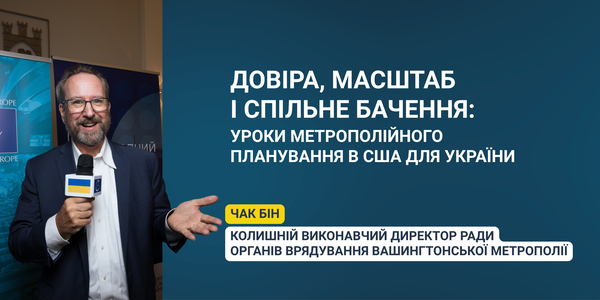
“Trust, Scale, and Shared Vision: Lessons from U.S. Metropolitan Planning for Ukraine”
Interview with Chuck Bean, Former Executive Director of the Metropolitan Washington Council of Governments (MWCOG)
(Interviewed during the Second International Forum of Agglomerations of Ukraine: “Agglomerations and Functional Territories – European Approaches and Their Implementation in Ukraine”, Lviv, 24 October 2025.)
– Mr. Bean, could you briefly introduce yourself and explain why you joined Forum of Agglomerations of Ukraine?
– Metropolitan governance is a common practice around the world — including in the United States. I served for ten years as the Executive Director of the Metropolitan Washington Council of Governments — what you could call the “agglomeration” for Washington, D.C., and its surrounding around 20 member governments in Maryland and Virginia. The Council began back in 1960, very small at first, and over time it grew into a regional institution supported by strong federal frameworks established in the 1970s and 1990s.
I came to Lviv as a volunteer, to share our story and to support Ukraine’s path toward effective metropolitan governance. My first connections to Ukraine came through my work with the National Association of Regional Councils in the U.S., and later through the European Metropolitan Network, METREX. When I heard that the Lviv Agglomeration’s office had just three staff members, I smiled — because at one point, my organisation also had three staff. Today, it has around 120. I wanted to show that growth is possible with time, trust, and cooperation.
– What are the main lessons from the U.S. metropolitan planning system that might be useful for Ukraine?
– The U.S. model developed through a combination of trust-building and legislation. There are now around 400 metropolitan planning organisations — one for every major urban area — all shaped by three key pieces of federal law. These laws established both the standards and the incentives that made regional cooperation not just possible, but necessary.
In my own region, our board brought together the Mayor of Washington, D.C., and the executives of neighboring counties. We focused on four main program areas: transportation planning, water quality and management, air quality, and public safety. Each city in the U.S. runs its own police and fire departments, so coordination among them is essential.
We host about 75 technical committees that meet monthly — police chiefs, fire chiefs, planners, transportation directors, water authorities. Our role is to serve as a hub for collaboration — where some efforts are voluntary, others mandated by federal law.
– You’ve mentioned U.S. federal legislation as a driver of collaboration. Could you explain how that works?
– In transportation, for example, U.S. law requires every urbanised area — not necessarily defined by city boundaries, but by population density — to have a metropolitan planning organisation (MPO). The MPO develops a 20-year regional transportation plan. Here’s the key: if a city wants federal funding for its infrastructure projects, that project must be part of the regional plan.
That creates a clear incentive: if you don’t cooperate, you don’t get federal funding. It’s a continuous, data-driven process — every four years, the plan is renewed, with a more specific six-year program beneath it. Projects are evaluated, analysed by technical staff, and debated by transportation directors before mayors vote. It’s not a “wish list”; it’s a shared, evidence-based roadmap.
– You also spoke at the Forum about water management as a model of regional cooperation. Why that example?
– Water management in the U.S. offers a great example of what I call a “forced marriage” — when cities must work together because nature leaves them no choice.
In the 1960s, American rivers were so polluted that some literally caught fire. Public pressure led to the creation of the Environmental Protection Agency (EPA) and the Clean Water Act, which required regional planning based on watersheds — not administrative borders. One city could be doing everything right, but if an upstream city was polluting, it wouldn’t matter. The law mandated that a single designated agency produce one plan for the entire watershed, not a patchwork of local plans.
The federal government also provided additional funding for cities that built joint infrastructure. In Washington, for example, this made possible the construction of the largest advanced wastewater treatment plant in the region — serving several counties.
Our organisation didn’t operate that facility, but we played a crucial role in analysis, coordination, and governance design. We facilitated a 100-year agreement among the participating jurisdictions — defining how they share costs, make decisions, and resolve disputes. That agreement still stands today, and it’s something I’m very proud of.
– What would be your advice to Ukrainian cities and regions developing their own agglomerations?
– The foundation of everything is trust — but trust alone is not enough. You also need clear rules, incentives, and reliable data. Ukrainian agglomerations could benefit from studying how U.S. and European frameworks combine voluntary cooperation with firm regulatory and financial structures.
Water, waste, and transportation are natural starting points. They require joint solutions and can attract international donors and investors after the war, especially if projects are developed at scale. A large, efficient regional initiative is always more appealing to funders than fragmented local efforts.
– You’ve worked closely with European metropolitan networks. Do you see opportunities for Ukraine to connect internationally?
– Absolutely. I’m part of METREX, the network of European metropolitan regions, chaired by Yakov Mazur from Wrocław. Their experience could be very relevant here — they’ve made incredible progress in just two decades. I was really glad to hear that, with support from the Council of Europe and its Centre of Expertise for Good Governance — a key partner in helping advance metropolitan governance in Ukraine — you’ve already started looking into how metropolitan governance works in Poland.
METREX holds two conferences a year — the next one is in San Sebastián. Aside from the conference, I think, a short virtual exchange between several Ukrainian agglomerations and a few European and American ones could be a great start.
– Finally, what message would you leave with Ukrainian leaders working to strengthen metropolitan governance?
– You don’t need to reinvent the wheel. Start small, build trust, and create structures that endure. Every major metropolitan system — including ours in Washington — began modestly, with a few people and a shared idea. What matters most is the commitment to collaborate for the long term.
This material was produced within the Council of Europe Action Plan for Ukraine “Resilience, Recovery and Reconstruction” for 2023-2026 and the project “Strengthening multilevel governance and local democracy to support Ukraine's recovery”, implemented by the Centre of Expertise for Multilevel Governance at the Congress of Local and Regional Authorities of the Council of Europe.
Source:
Програма Ради Європи
04 December 2025
Багаторівневе врядування на практиці: підсумки регіонального форуму Polaris
Багаторівневе врядування на практиці: підсумки...
3 грудня у Полтаві відбувся регіональний форум Програми Polaris «Розбудова системи багаторівневого врядування» –...
04 December 2025
15 грудня - круглий стіл «Громада як юридична...
Центр політико-правових реформ запрошує взяти участь у дискусіях на круглому столі «Громада як юридична особа...
04 December 2025
Мінфін у листопаді забезпечив перерахування з...
У листопаді 2025 року Мінфін згідно з бюджетним законодавством забезпечив перерахування міжбюджетних трансфертів до...
03 December 2025
Вакансія: Місцеві експерти з планування управління відходами (WM4U)
Вакансія: Місцеві експерти з планування...
Програма WM4U оголошує відбір двох експертів з планування у сфері управління відходами для роботи з кластерами...