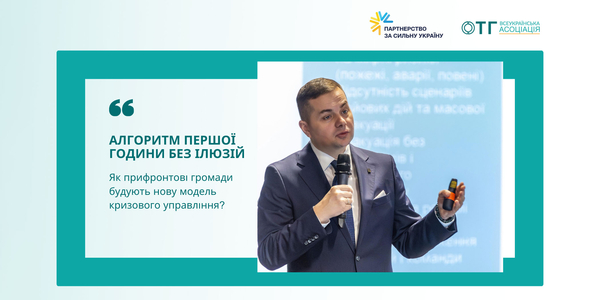
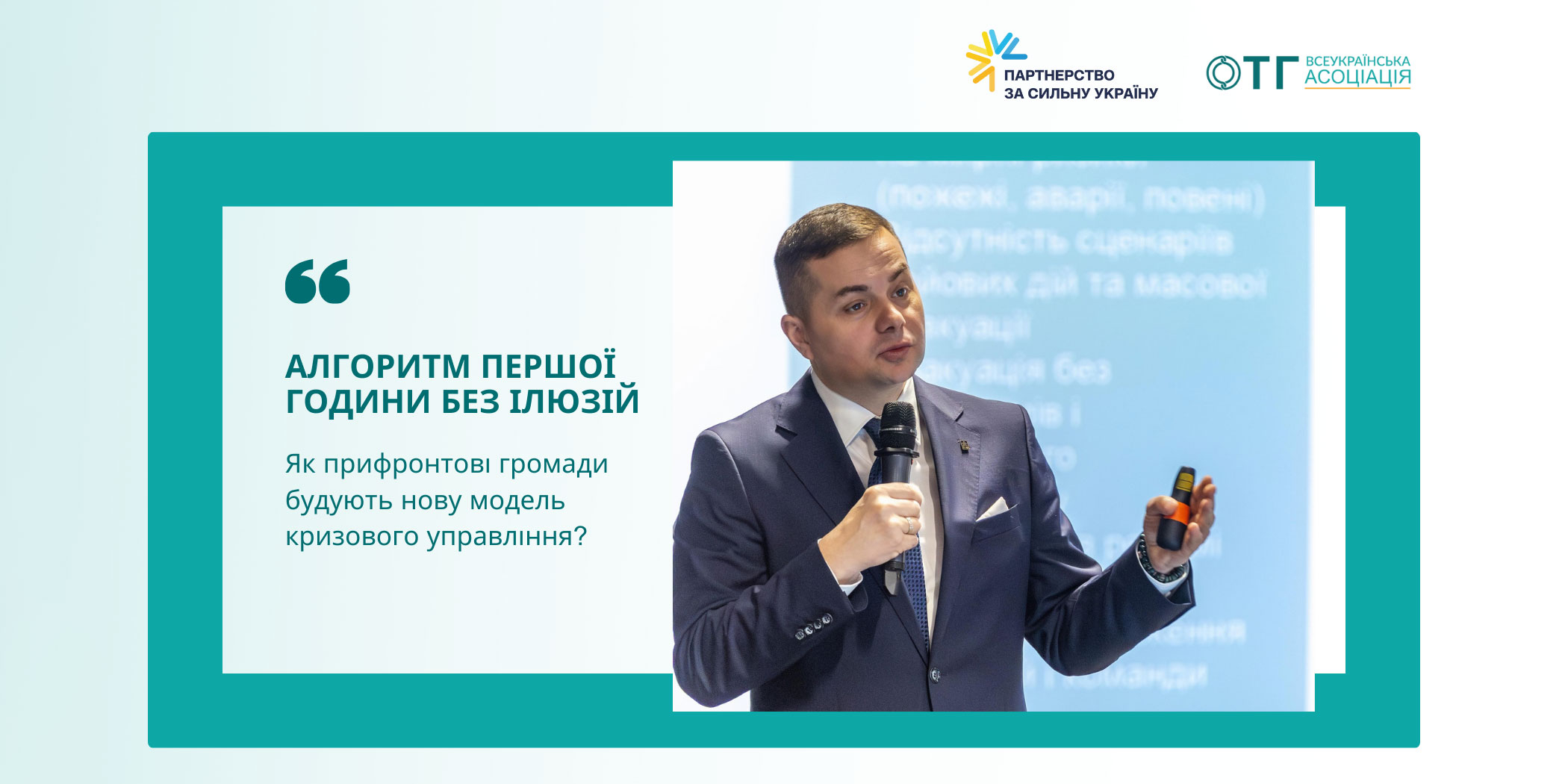
First hour algorithm without illusions: How frontline communities are building a new model of crisis management
Decentralised emergency management systems respond twice as quickly and reduce casualties by half compared to centralised systems. A study on the role of local governance in disaster preparedness and response systems and enhancing community resilience (2025) found that the decentralised model provides a response time of six hours, compared to 12 hours for the centralised model. It also reduces the number of casualties from 100 to 50 and economic losses from USD 300 million to USD 150 million. Using a mixed approach combining case studies, expert interviews and statistical analysis, the study showed that decentralised management characterised by strong local leadership and community involvement significantly increases disaster resilience. However, this advantage only applies if local authorities are able to establish control over the crisis within the first hour.
When speaking with communities, I have often heard that most have evacuation plans, response protocols and approved structures in place. However, when a crisis hits – such as shelling, power outages or the threat of occupation – these documents remain theoretical. Representatives of frontline communities shared their experiences from 2022. In the first hours after the start of the full-scale invasion, or during the threat of evacuation, they found that the biggest problem was losing control due to the management team becoming dispersed. Some team members were in occupied territory, some were on the road, some were out of contact and some remained at the checkpoint. There was also no pre-determined system for replacing powers.
During a series of training sessions on adaptive planning for frontline communities in January 2026, we discussed with participants the concept of the ‘first hour algorithm’ – an approach that could transform the philosophy of crisis response itself. This work was carried out within the framework of a project supported by the Partnership Fund for a Resilient Ukraine, with participants being representatives of communities living under constant threat. We did not discuss theory. We talked about what works here and now.
The operational minimum necessary for the first hour algorithm to work
The ‘first hour algorithm’ is a concept derived from military experience and international practices in emergency management. It is not about heroic deeds. Rather, it is about establishing or losing control. It is about whether you save critical assets or lose control of them. It is about containing chaos or defending against it. Essentially, it is a specific sequence of actions that must be performed within the first 60 minutes after an incident occurs. However, this approach does not work on its own. A foundation must be laid before the crisis, which we call the operational minimum.
The operational minimum consists of five mandatory management elements that must be established before a crisis, ensuring that decisions do not have to be made from scratch during the crisis itself. The first of these is continuity of leadership, achieved through a three-level replacement system involving specific individuals who will definitely remain in post, as well as direct channels of communication. The second element is the distribution of responsibility. Three to five key roles should be defined, each with specific tasks such as the evacuation of people, critical equipment and cultural heritage, and the coordination of communication with services and the population. The third element is operational communication. There are three channels for each role: telephone (mobile communication), the internet or messengers on different operators, radio, etc. All channels are tested before the event. The fourth element is controlling actions through predefined checkpoints. Rather than waiting for reports, take the initiative and make contact yourself. The fifth is the protection of three critical assets: human life, critical equipment and data, and cultural heritage.
Three critical community assets
The fifth element of the operational minimum, protecting critical assets, requires further explanation. This is not a list of priorities from which items can be dropped in the event of adverse circumstances. These three pillars are fundamental to the community’s ability to survive, function, and recover.
The first asset is people's lives and safety. This includes everyone, without exception: people with limited mobility, people with disabilities, the elderly, and children. Without people, there is no community. The key principle is that all evacuation decisions must be as people-centred and inclusive as possible. The second asset is critical equipment and digital assets. This includes servers, databases, archives, and expensive equipment. The aim is to ensure that services can continue to be provided after returning to a de-occupied community or relocating the administration to a new location. Without these assets, the community loses its functionality, even if people and buildings are preserved. The third asset is cultural heritage and historical memory. This includes museum collections, archives, monuments, and symbolic community objects. It is no coincidence that the occupier is systematically destroying Ukrainian cultural heritage – it is an attempt to erase evidence of the existence of a unique community in this territory. Without cultural memory, the community risks losing its identity.
All three assets must be planned for in parallel: preventatively, through the formation of response and evacuation plans; and during the first hour of a crisis, by keeping these plans in mind when making quick decisions.
The first hour algorithm during a crisis
The first hour algorithm is divided into four 15-minute phases, each of which uses elements of the operational minimum. The first fifteen minutes are for activation, during which time it is necessary to establish who is in charge, record the start time of the event, determine what has happened and activate all internal and external resources. This is where continuity of command and control of execution come into play.
The next fifteen minutes are for communication, during which time the first important decisions should be made, specific executors assigned, and quick reports obtained from those responsible for critical objects. The SITREP technique (more on that later) is used for situational reports during this phase. This is the phase of responsibility allocation and operational communication.
Thirty to forty-five minutes – execution: coordination with services; constant monitoring of the status of facilities via control points; launch of critical asset protection protocols. The final fifteen minutes are for stabilisation: the situation is under control, the scale of the consequences is understood, the direction of further actions is determined and information is passed on to a higher level of coordination. If, sixty minutes after the event, you can clearly answer the questions ‘Who is in charge?’, ‘What are we controlling?’, and ‘Where are we going next?’, the algorithm has worked.
SITREP-15: when every second counts
One of the most practical techniques that we practised during the training sessions was SITREP-15, a rapid situation report adapted from military practice. Imagine this: during a shelling, the community leader calls the museum director. What should they hear? Not a long story about what happened, how it happened and who is to blame. No – they need five specific facts in three minutes to make a decision.
The SITREP technique involves answering five questions: what happened in one sentence at most; where the worst is, up to three points; communication and travel – yes, no or partially; two risks for the next two hours; and two specific requests for services or the regional administration. Nothing more. No embellishment, no emotion, just facts for decision-making.
When theory meets reality
During the group exercises, the participants not only practised techniques, but also shared their experiences of what really works in crisis situations. One of the most powerful moments was analysing a real case study from a starosta in an area of active combat. A wounded resident, territory under the control of enemy drones, no mobile communication and no ambulances able to arrive due to the threat of drone attacks.
The starosta, who is trained as a paramedic, acted in accordance with a clear algorithm: he arrived at the scene, applied a tourniquet, moved the victim from open terrain to shelter, found an employee and, together, they moved the victim to a safer area. They then provided first aid, notified the administration via the sole operational communication channel, found a car and took the victim to hospital. This clearly corresponds to the structure of the algorithm for the first hour after a crisis event begins: activation, communication, execution, and stabilisation.
Other participants emphasised the importance of practical and mandatory medical training for all starostas and responsible persons. Representatives of frontline communities also shared practical solutions, such as the 30-minute rule for communication control: if someone does not respond within half an hour, the situation is checked immediately, rather than being left to wait.
Conclusions
The first hour is the moment when the choice between establishing and losing control is made. This choice is not made during the crisis itself. It is made during preparation, training, and rehearsing procedures. In the first hour, the community leader or authorised person de facto becomes a disaster manager – a manager of emergency situations. This is, of course, figurative: you do not replace the State Emergency Service, the police, or medical professionals. However, you are responsible for initiating response processes and plans, assigning roles, making decisions in uncertain conditions, maintaining public communication, and ensuring the protection of the community’s three critical assets: people, critical equipment, and cultural heritage.
Nobody is born a crisis manager. These are skills that can be trained. The more resilient and trained we are before a crisis, the more resilient we will be during it. This model requires strong leadership on the ground and regular crisis management training. It is this leadership that determines whether paper plans will be translated into action in that critical first hour.
The project ‘Adaptive Emergency Planning for Frontline and Border Communities’ is implemented by the All-Ukrainian Association of Local Governments ‘Association of Amalgamated Territorial Communities’ with the support of the Partnership Fund for a Resilient Ukraine, which is funded by the governments of the United Kingdom, Estonia, Canada, Norway, Finland, Switzerland and Sweden.
The contents of this publication are the sole responsibility of the All-Ukrainian Association of Local Governments ‘Association of Amalgamated Territorial Communities’ and do not necessarily reflect the views of the Programme and/or its financial partners.

Author: Олександр Чекригін
Source:
Всеукраїнська Асоціація Органів Місцевого Самоврядування «Асоціація Об'єднаних Територіальних Громад»
11 February 2026
Мінфін розпочав підготовку Бюджетної декларації на 2027–2029 роки: що це означає для громад
Мінфін розпочав підготовку Бюджетної декларації...
Міністерство фінансів України стартувало підготовку Бюджетної декларації на 2027–2029 роки – ключового...
11 February 2026
I_CAN запрошує громади Київщини на навчання з управління публічними інвестиціями
I_CAN запрошує громади Київщини на навчання з...
Представників органів місцевого самоврядування Київської області запрошують долучитися до Національної навчальної...
11 February 2026
Анонс вебінару: «Регулювання діяльності...
Особливості реалізації законодавства про регулювання діяльності комунальних юридичних осіб у перехідний період...
11 February 2026
Навчальна платформа для керівників ЦНАП: стартує сьомий набір
Навчальна платформа для керівників ЦНАП:...
Програма Polaris «Підтримка багаторівневого врядування в Україні» запрошує на навчання керівниць та...