How Balta community turned an educational partnership with its neighbours into a strategic advantage
Partnerships between communities, particularly in education, have evolved from a mere aspiration to a strategic necessity. In Balta community in Odesa region, there is a strong belief that this is the only way communities can develop fully.
‘No community, not even the most capable, can provide the full range of high-quality services on its own. Meanwhile, cooperation must be based on trust and underpinned by legislation,’ says Valerii Zhelikhovskyi, Deputy Mayor of Balta for Social Affairs.
Balta community actively cooperates with partners both in Ukraine and abroad (it has up to 20 European partner cities). Apart from education, cooperation covers the healthcare sector (cluster hospital), youth policy, sport, and public utilities.
In this article, read about the experience of developing cooperation around the Centre for Professional Development of Teaching Staff of the Balta City Council.
Innovation and partnership needs
The Centre for Professional Development of Teaching Staff in Balta was established in 2020 as a direct response to the new Law on Education, which required a reform of the professional development system.
‘Currently, there are three consultants and a director at the Centre – that is, me. We organise professional development for teachers from all types of institutions: secondary, pre-school, and extracurricular education. Overall, the Centre functions as a hub that brings educators together. The law also stipulates that every teacher must complete 150 hours of professional development over a five-year period. Therefore, there cannot be a situation where any teacher is not included in this process. This is a mandatory requirement,’ notes Svitlana Tkach, Director of the Centre for Professional Development of Teaching Staff.

A key element of the organisation is the mentoring service, established back in 2017–2018.
‘Even back then, we realised it was unrealistic to employ a staff of 15 subject specialists who were experts in just one subject. Each of them was responsible for two or three subjects, but their main focus was on one subject, whilst the other two suffered. Currently, the mentoring service consists of subject teachers who teach only one subject and are the best in their field. They organise work directly with teachers who need assistance and receive additional remuneration for this work. This gives them the opportunity to explore the subject in depth and address every request thoroughly,’ says Petro Kulyk, Head of the Education Department at the Balta City Council.
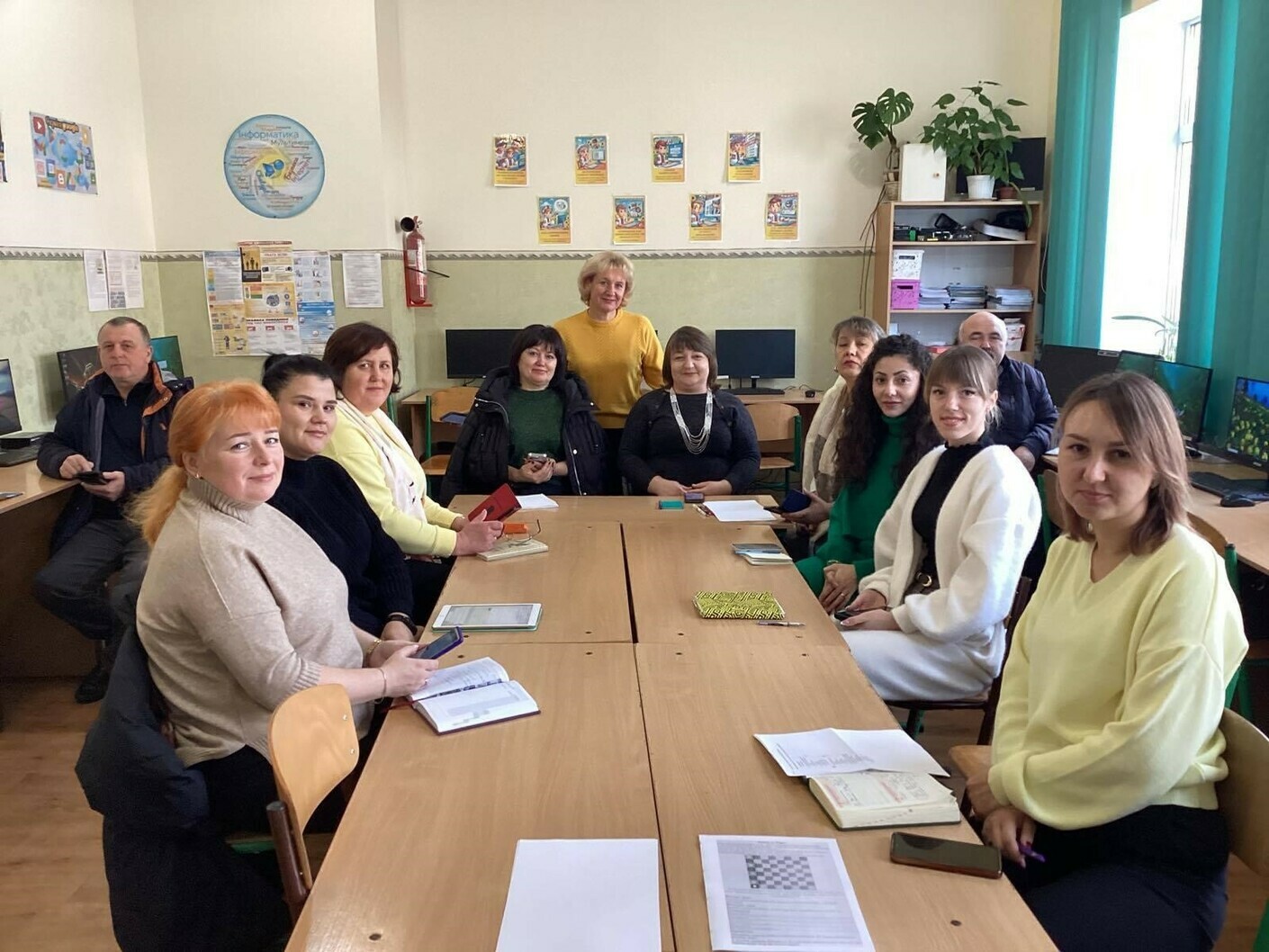
During one of the meetings with teachers
Such an approach helps the Centre to be as responsive as possible to the needs of practising educators. The Centre conducts surveys and makes enquiries with educational institutions in other communities to understand the needs of teachers as they stand.
‘High-quality education requires the constant updating of knowledge and skills. And our mentors are the best, most active innovative teachers who are practitioners themselves. They work closely with educators and are the first to hear their requests. We then meet these needs through collaboration with other professional development providers: we involve national and international projects. This fosters a constant exchange of experience and collaboration even at the national level, as some of our teachers are themselves national trainers,’ says Svitlana Tkach.

Currently, the services of the Centre cover almost 100% of teachers in Balta community and over 60% of staff in neighbouring partner communities, including Pishchana and Kodyma communities.
The need for partnership became obvious at the very beginning of the reform of senior schools. Valerii Zhelikhovskyi recalls:
‘We were among the first 139 communities to be mapped in Ukraine. Even then, we realised that providing the full range of services at the community level would be difficult. So we needed to understand how to build partnerships with neighbouring communities.’
Communication was at the level of deputy mayors:
‘We asked each other, “How are the things going with you? What are you doing?” When we shared the range of services provided by the Centre for Professional Development, people were surprised. They said, “You’re our neighbours, and we didn’t even know you had so much on offer.” And now, during martial law, we can see how this cooperation gives us significant advantages. Due to the unpopularity of the teaching profession, young people are not very keen to work in schools. However, the quality of educational services must remain high. Therefore, the continuous professional development of teachers helps to maintain standards at the appropriate level.’
Cooperation with DECIDE: legitimisation and the financial model
However, cooperation with neighbouring communities initially took the form of unwritten agreements. Later, with the help of DECIDE experts, it was successfully formalised.
‘I remember the Deputy Mayor of Kodyma community phoning me one day and saying, “There’s a great project on community cooperation. I know you can fill in the application effectively and describe everything; we’ll help with everything – we’re ready to move forward together!”,’ says Petro Kulyk.
The community cooperation initiative from DECIDE is based on the idea of mutual support and strengthening. Cooperation enables communities to compensate for a lack of their own services, specialists or institutions by drawing on their neighbours. Furthermore, pooling financial and human resources allows partners to create and implement joint, more ambitious projects.
‘Following the closure of the methodological department, we need professional support more than ever. We are unable to set up our own Centre for Professional Development, and indeed it would be impractical given the number of teachers we have. There is only one solution – to join forces. Cooperation with the neighbouring community opens up many opportunities for us: regular meetings, learning about new methodologies and legislation, and exchanging experiences. Such interaction has a truly positive impact on our work,’ explains Serhii Revenko, Head of the Department of Education, Youth and Sport at the Kodyma City Council.
Balta community took advantage of the expertise of DECIDE Project and signed an agreement to implement a joint project. They decided to launch official cooperation focused on the Centre for Professional Development of Teaching Staff.
‘This gave us the opportunity to streamline processes and comply with the legal framework,’ explains Petro Kulyk.
A symbolic fee is charged for the Centre’s services to other communities, calculated per teaching staff member, which partially covers the Centre’s running costs.
Thanks to a DECIDE Project mini-grant of UAH 130,000, laptops were also purchased.

‘We stream 30–50% of our events online. This lets us deliver services without logistical hurdles, whilst enabling teachers to improve their digital skills. But, of course, we prefer face-to-face meetings, as they are more effective and also provide psychological support. When the community is small and teachers have limited opportunities to socialise, joint meetings support their mental health. Being part of a community and interacting with others is a huge benefit and a challenge of our time,’ says Svitlana Tkach.
Sharing best practices and the strategy for development
‘Every community has its own unique strengths. For example, programming is well-developed in Kodyma community, whilst robotics is strong here. And the opportunity to inform and complement one another through this collaboration is even more important than the actual signing of an agreement. We are interested in sharing what we have with others and learning from each other in return,’ says Petro Kulyk.
This kind of interaction is the basis for the emergence of professional communities:
‘It is a challenge to seek out people who share the same ideas and create professional communities. Without this interaction, the communities would not have formed. People find common ground in their professional activities. Each subject mentor acts as a coordinator for their community. And when the question arises, “What should I do now? How can I overcome difficulties in the educational process?”, these communities help find the answer,’ says Svitlana Tkach.
Indeed, cooperation between communities and the formation of communities helps find answers to questions about how to overcome difficulties in the educational process. In the future, the community plans to use its partnership experience to address global educational challenges.
‘The strategic idea is to establish a lyceum by 2027. And here we already need to think about reorganising the network. We also need to consider our neighbours; for example, Pishchana community will not have its own lyceum. And we need to attract their children to ours,’ says Valerii Zhelikhovskyi.
The idea of forming a triumvirate with a vocational teacher training college, which has vacancies in its halls of residence, is being considered.
‘We understand that the future will bring new challenges,’ adds Valerii Zhelikhovskyi. ‘We are already beginning to grow into the position where we can try to hold a conference at a joint level. This will certainly provide an opportunity to scale up our partnership and try to open a new chapter in communication between educators.’
Svitlana Tkach sums up:
‘We have many shared plans: to use common digital platforms, exchange experiences, develop mentoring programmes, and organise educational trips to learn from the experiences of other Professional Development Centres.’
Recently, inspired by the cooperation around the Centre, the community signed official cooperation agreements in various fields with Zelenohirske, Pishchana, Slobidka, and Kodyma communities.
“For example, we have a centre for teaching the subject ‘Defence of Ukraine’. Pupils from two communities – Slobidka and Pishchana – travel there. They contribute their own co-funding for each child. Therefore, there is financial cooperation here as well. We held preliminary hearings, discussed, calculated budgets, and prepared cost estimates. That is quite a lot of preparatory work. But we were already building on our initial experience, so it was much easier to implement,” says Petro Kulyk.
The community says that through official cooperation, the process is regulated and brought into the legislative framework. This ensures clear compliance with key financial laws, the Budget Code, and the legislative framework. This means accountability for both parties and guarantees.
Mariia Buleiko (Markovska)
08 May 2026
Мінфін перерахував громадам 20,2 млрд грн трансфертів у квітні
Мінфін перерахував громадам 20,2 млрд грн...
У квітні 2026 року Міністерство фінансів України забезпечило повне – на 100% – перерахування міжбюджетних трансфертів...
08 May 2026
Чому ваша громада вирішує без вас і хто за це відповідає?
Чому ваша громада вирішує без вас і хто за це...
62% українців готові брати участь у публічних інвестиціях — але система їх не чує. Дослідження ГО «Проти Корупції»...
07 May 2026
Оцінка фінансової спроможності громад...
Дубенська районна військова адміністрація розробила та успішно застосовує «Компас оцінки громад» — власний...
07 May 2026
Куди має зараховуватися ПДФО? Аналітика та дорожня карта переходу
Куди має зараховуватися ПДФО? Аналітика та...
ПДФО — основа місцевих бюджетів і формує до двох третин усіх податкових надходжень. Від нього залежить, які...