From legislative changes to public assemblies: Project of the Council of Europe assesses annual results of support for local self-government in Ukraine
Whilst Ukraine is at war, rebuilding its destroyed territories and preparing for accession to the European Union, local self-government reform continues to advance. Behind many of the decisions that today shape the future model of multilevel governance, the development of inter-municipal cooperation, open government, and community recovery lies the sustained expert work of international partners.
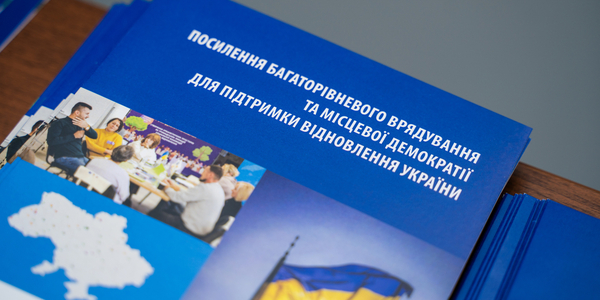
The project of the Council of Europe “Strengthening multilevel governance and local democracy to support Ukraine’s recovery” presented the results of its work for the period from April 2025 to May 2026.
As the Council of Europe Office in Ukraine reports, the Project continues to support the development of local self-government and multilevel governance in the context of full-scale war, combining assistance in implementing reforms with practical support for communities.
The Project covers three interrelated areas: improving the legislative and institutional framework for multilevel governance in line with the European Charter of Local Self-Government; enhancing the quality of local self-government through capacity building for authorities at different levels; and supporting democratic innovation and civic participation.
Support for key reforms
Over the course of the year, the Project provided legal expertise, advisory support, and dialogue between government authorities at various levels on the further development of the system of local self-government.
One of the results in this area highlighted by the Council of Europe Office is the adoption of Ukrainian Cabinet of Ministers Resolution No. 1748 on reforming local self-government and the territorial organisation of power under martial law and in preparation for EU accession, the entry into force of Ukrainian Law No. 4425-IX on the development of cooperation between communities, as well as the adoption at first reading of Draft Law No. 14412 “On the Principles of Delineation and Distribution of Powers between Levels of Public Administration”.
The Project also contributed to the development of metropolitan cooperation, the drafting of legislative proposals on the delineation of powers between levels of authority, and the improvement of approaches to legal supervision in local self-government.
Open government and human rights
Special attention was paid to the development of open government and the engagement of citizens in decision-making.
In the framework of the new cycle of local initiatives for 2025–2026, the communities of Smila, Kamianets-Podilskyi, Ivanivka, Ternopil, Bila Krynytsia, and Hlyboka received direct financial and expert support. Two more communities, Zviahel and Orzhytsia, received additional support to implement their action plans. All initiatives are implemented in partnership with civil society organisations.
Representatives of Ukrainian communities also attended the OGP Global Summit in Spain, where they presented their own experience of implementing the principles of open government and public participation.
In terms of open government and human rights, more than 200 participants received training on relevant principles and practices, whilst a roundtable dedicated to supporting citizens when submitting claims to the Register of Damage for Ukraine brought together more than 500 participants.
Support for restoration and development of communities
One of the priority areas has been helping communities prepare for restoration and long-term development.
April marked the completion of the second cohort of the Academy for Community Recovery, which brought together community representatives from 17 regions of Ukraine during a six-month period. The participants learnt strategic planning tools, worked on resource mobilisation, and developed projects for the reconstruction and sustainable development of their communities.
In parallel, almost two thousand representatives of local governments took part in capacity-building events on public investment management, service in local governments, and spatial planning. The focus was particularly on the development of the Lviv, Kyiv, and Ivano-Frankivsk agglomerations.
Spatial planning as a tool for restoration
In the context of post-war restoration, the Project placed significant emphasis on the development of spatial planning.
A series of express training sessions for representatives of more than 200 communities brought together over 400 participants. The training covered issues relating to the integration of strategic, spatial, infrastructure, and budgetary planning, as well as the use of data for management decision-making.
Democratic innovation and citizen participation
Democratic innovation and the introduction of mechanisms for deliberative democracy have been a notable part of the Project's work.
Through the mechanism of Community Assemblies, local residents have been given the opportunity to participate directly in the development of recommendations for local authorities. For instance, in Rivne community, participants developed 20 recommendations on creating conditions to encourage young people to stay and work in the community. In Obolon district of Kyiv, 24 recommendations were formulated to improve support for veterans and their families. A similar process will soon begin in the Lviv agglomeration.
To disseminate these approaches, the Project also strengthened the capacity of 80 representatives of public authorities and civil society in deliberative democracy.
Youth as participants in local self-government
A key achievement of the year was the expansion of the inclusive participatory budgeting scheme in schools.
Eleven Ukrainian communities have already adopted the relevant regulations and are implementing this mechanism in line with Council of Europe standards. Thanks to this, over 6,200 children, including students with special educational needs, have been given the opportunity to participate in voting and decision-making at their schools. A further six communities are preparing to launch the scheme in autumn 2026.
To promote the adoption of this practice, the Project, in cooperation with EGAP programme, has developed a special online course for local governments, educational institutions, and schoolchildren.
The project “Strengthening multilevel governance and local democracy to support Ukraine’s recovery” is implemented by the Centre of Expertise for Multilevel Governance at the Congress of Local and Regional Authorities of the Council of Europe as part of the Council of Europe Action Plan for Ukraine “Resilience, Recovery and Reconstruction” 2023–2026.
Source:
Центр експертизи багаторівневого врядування
02 June 2026
Місто української слави. Інтерв’ю голови Очаківської міської ради Сергія Бичкова
Місто української слави. Інтерв’ю голови...
Голова Очаківської міської ради Миколаївської області капітан-лейтенант запасу Сергій Бичков про тисячі квадратних...
02 June 2026
Вакансія: Спеціаліст (-ка) з комунікацій
Вакансія: Спеціаліст (-ка) з комунікацій
Опис контексту Для реагування на мінливі потреби українських муніципалітетів і національних суб'єктів у воєнний...
01 June 2026
Усунення диспропорцій в НГО земель: що змінює постанова Кабміну № 676 для громад
Усунення диспропорцій в НГО земель: що змінює...
Уряд ухвалив довгоочікувані зміни до Методики нормативної грошової оцінки (НГО) земельних ділянок. Постанова КМУ №...
01 June 2026
Анонс: вебінар «Актуалізація даних працівників...
Запрошуємо керівників закладів загальної середньої освіти та представників територіальних громад долучитися до...