Communities in Europe Solutions of the Month
July 2026
Ukrainian communities are becoming more and more integrated into the European political, legal, and professional space. However, the European integration of local self-government is not merely a matter of adapting legislation or meeting formal requirements. It is important to understand what decisions the municipalities of other countries are taking today, what challenges they face, and how the models of local governance are changing.
Throughout Europe, reforms of the territorial organisation of power are underway, local finance systems are under review, the powers of municipalities are expanding, inter-municipal cooperation is developing, and digital technologies are creating not only new opportunities but also new areas of responsibility for local authorities. Some of these discussions directly echo the challenges that Ukrainian communities are currently facing.
Therefore, the Decentralisation Portal is launching a regular monitoring programme of local self-government in Europe. We will select solutions, reforms, and practices that help to provide a broader picture: where local authorities are heading in different countries, which approaches have already proven themselves in practice, and what lessons from this may be useful for Ukraine.
This is not an attempt to mechanically replicate the models of other countries. Local self-government systems have developed under different historical, legal, and financial circumstances. However, comparison provides an opportunity to better evaluate our own decisions, spot new trends faster, and engage in the European professional debate not merely as observers, but as partners with our own experience to contribute.
The first overview covers the reorganisation of local self-government in England, new EU approaches to regulating artificial intelligence, financial equalisation, and support for small municipalities in Italy, as well as the configuration of the financial system for decentralisation in Portugal.
Devolution in England: amalgamation of communities, a new distribution of powers, and the challenges of the reform
Today, this country – which is one of our key strategic partners – is undergoing its next phase of large-scale structural reform of local self-government, known as the Local Government Reorganisation. This process involves a review of the model of local governance, including the amalgamation of certain administrative entities and the redistribution of powers.
In Ukraine, this process is most often referred to as “decentralisation”, whereas in the United Kingdom the broader context of the transfer of powers from the central government to the regions is known as “devolution”. To better understand what is actually happening at the moment, the preconditions and specific features of this reform are worth examining in more detail.
Devolution applies to England, while Scotland, Wales, and Northern Ireland have already implemented these reforms.
Although the reform itself was launched in the 1990s and took place in several phases, the key document for the reform is the “English Devolution White Paper” (similar to Ukraine’s “Concept for the Reform of Local Self-Government and Territorial Organisation of Power” (2014)) was proposed and published by the UK Government only on 16 December 2024.
The aim of the reform is to move away from the two-tier model of local governance and replace it with a single-tier system of local self-government, in which the majority of powers are concentrated at the level of a single body of local authority.
In fact, the levels of authority used to be as follows:
- Central Government
- County Council. Similar to something between the regional and district levels, with a population of 500,000–1.5 million.
- District Council. A district council, comprising several small municipalities, similar to Ukrainian amalgamated territorial communities but with fewer powers, with a population of between 100,000 and 150,000.
- Parish Council / Town Council. Similar to a starosta district, or a community self-organisation body, with a population ranging from several hundred to 10,000 residents.
Under the new system, county and district councils are eliminated and replaced by new administrative-territorial units.
- Central Government
- Unitary Authority. Target number of residents: 500,000.
- Parish Council / Town Council
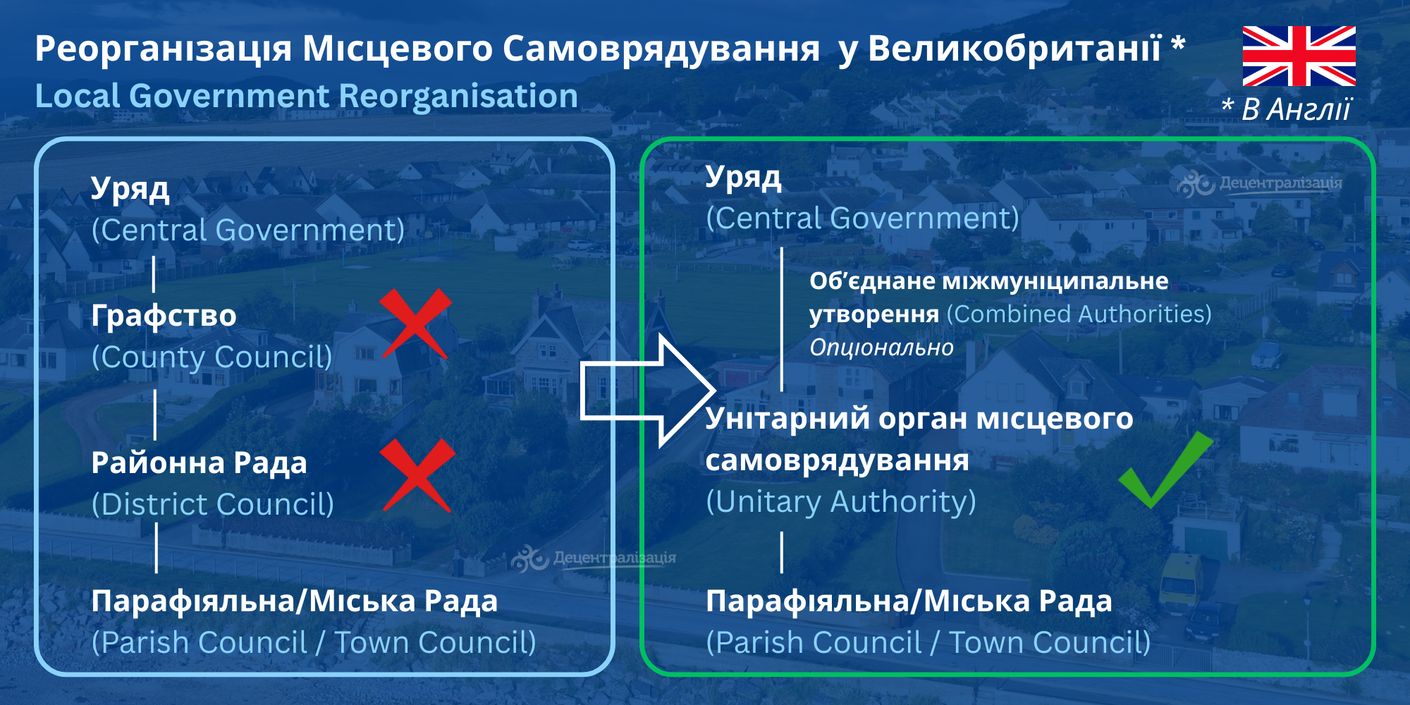
One of the main reasons behind the need for change – as was the case in Ukraine during the decentralisation reform – was the duplication of powers between the two levels of local governance, the counties and the district councils, and the lack of coordination between them. This model complicated the decision-making process, created additional administrative costs for maintaining the administrative apparatus, and often led to a lack of understanding among residents as to which level of authority was responsible for specific services.
Moreover, the small number of residents and limited resources in many districts complicated the performance of more complex modern functions, in particular strategic planning for the development of territories, digital transformation, the provision of social services, and the management of large-scale infrastructure projects.
Some counties may be retained, but primarily as historical and cultural entities without any real administrative powers. Instead, unitary authorities are to be established in their place; in terms of their role, these are the closest equivalents to Ukrainian amalgamated territorial communities, though on a much larger scale. They will assume the powers that were previously divided between counties and district councils.
Meanwhile, in some powerful and economically developed regions, an additional level of cooperation may emerge – Combined Authorities. These may be established by several Unitary Authorities within a single functional economic region to jointly manage issues such as transport, economic development, investment, housing, and spatial planning.
Such bodies are typically formed around major cities, their suburbs, and neighbouring areas that have close economic ties. In the Ukrainian context, the closest equivalent to such models is urban agglomerations.
There are currently 65 unitary authorities in England, established during the first three waves of reform between 1995 and 2019. As a result of the current phase of reorganisation, about 30 more such authorities are planned to be established. Thus, the total number of unitary authorities can approach 100, although the final number will be determined once the relevant decisions have been approved by the Central Government.
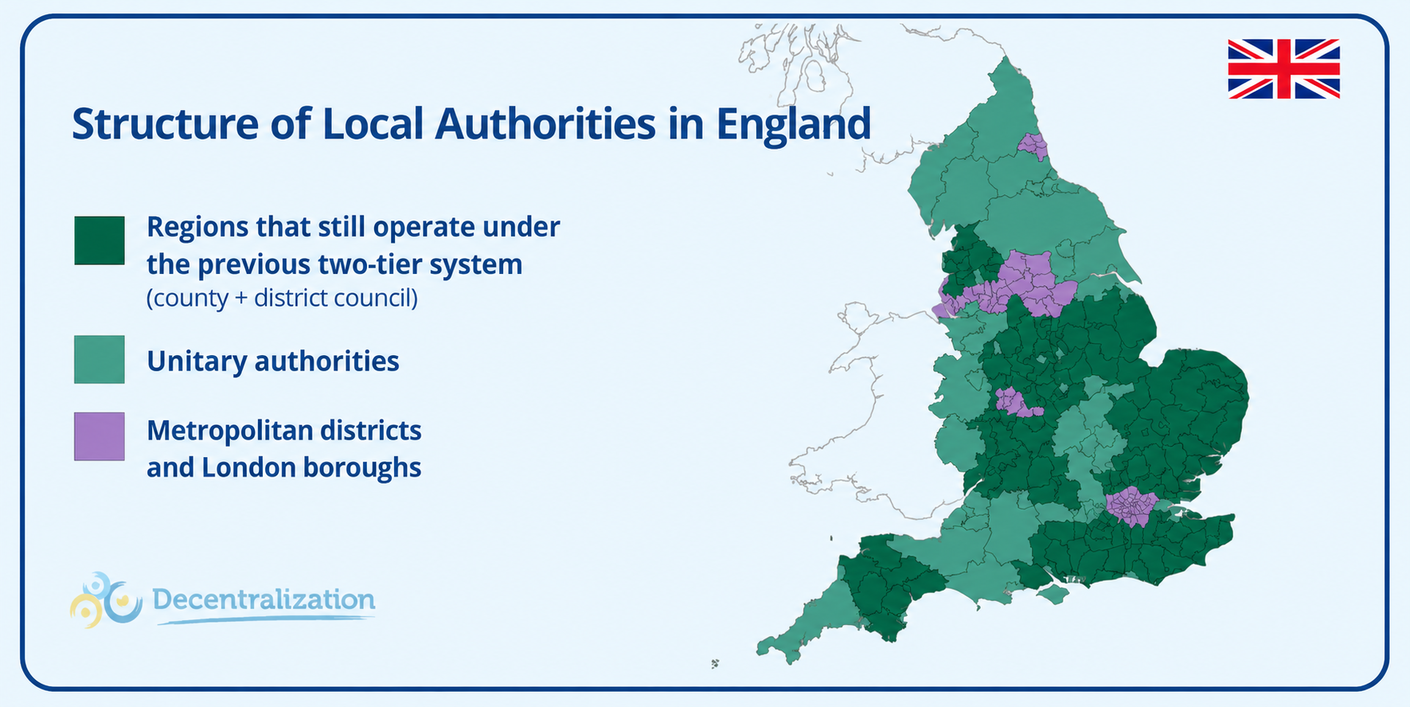
Following the publication of the Devolution White Paper in 2024, the British government invited all areas where the two-tier model of governance – counties and district councils – remains in place to draw up their own proposals regarding the future structure of local governance. This includes defining new administrative units, their boundaries, optimal population sizes, financial models, and governance systems.
However, despite more than 30 years’ experience of reforming local self-government, further transformation is not taking place without debate and resistance. Some local government representatives have expressed concerns about the scale of the reform, the proposed implementation timetable, and the potential consequences for local democracy, the quality of services, and the ability of the new bodies to effectively represent the interests of communities.
However, the process of reorganising local self-government in Great Britain is not without controversy. In 2025, some of the existing local councils, primarily district councils, challenged the legality and fairness of the government’s approach to implementing the reform by bringing legal proceedings. The claimants argued that the government had set excessively tight deadlines for the implementation of the changes, was effectively encouraging the creation of large-scale consolidation models, and was postponing local elections without sufficient democratic justification.
The courts did not uphold the position of the claimants, and the government rejected the claims, noting that the criteria set out were of an advisory nature, consultations with the local authorities were ongoing, and the process of reorganising local self-government was proceeding in line with current legislation. In parallel, the government is developing and implementing a system of financial incentives for the newly established administrative-territorial units.
The process of consultation and shaping the future structure is currently underway. The boundaries of the new administrative-territorial units are to be approved by the government and endorsed by Parliament in the course of 2026. Local elections are scheduled for May 2027, and from the start of 2028, the newly established unitary local governments are to begin fully performing their functions.
However, the reform will not end with this. The next stage in the plans of the Government is to expand the financial autonomy of the regions and to transfer additional powers in transportation, economic development, investment attraction, housing policy, vocational education and other areas. Particular attention will be paid to the development of Combined Authorities, which are intended to strengthen cooperation between unitary local authorities within functional economic regions.
We will therefore monitor further developments in the United Kingdom. The British reform, like British tea, takes time to reveal its full flavour.
For more information on the reform, visit the website of the Library of the House of Commons of the Parliament of the United Kingdom
Artificial intelligence in local governance: EU simplifies rules for digital transformation
We move from the UK to the continent – specifically to Brussels – where we learn that the Council of the European Union approved changes aimed at simplifying and clarifying the rules related to artificial intelligence (AI).
The new approaches are intended to reduce the regulatory burden on local governments and other organisations that implement digital solutions, whilst maintaining requirements for security, transparency, and the protection of citizens’ rights.
For local governments in EU countries, this means more time to prepare for the full implementation of AI legislation. Municipalities will be able to gradually adapt their internal procedures, train staff, and assess and mitigate the risks associated with the use of algorithms in public administration.
Currently, artificial intelligence is used increasingly widely at local level across the EU to process requests from residents, operate digital services, optimise transport and energy systems, manage public utilities, and analyse data to support management decision-making in municipalities.
Meanwhile, simplifying the rules on the use of artificial intelligence does not eliminate the responsibility of local authorities. Local governments have to ensure that AI systems used to support administrative processes are transparent and non-discriminatory, and that their use is subject to appropriate human oversight, especially in areas that may affect the rights and legitimate interests of EU citizens.
EU countries pay increasing attention to the use of artificial intelligence specifically at regional and local levels. The European Committee of the Regions emphasises that cities and regions should play a key role in the implementation of AI, whilst it is important to prevent a “digital divide” between municipalities with different levels of resources and expertise. This trend is expected to continue, and the development of responsible AI use at the local level will remain one of the priorities of the EU’s digital transformation.
For Ukrainian communities on the path to European integration, the experience of European municipalities serves as an important guide. Communities should already be developing their own approaches to the use of AI: establish rules for procuring digital solutions, designate responsible individuals, keep records of such systems, and take into account the requirements of European regulations, given that domestic Ukrainian regulations are only just beginning to be developed.
From Brussels, we head to the Apennine Peninsula.
Italy allocated over EUR 3.67 billion to municipalities: priority given to empowering rather than amalgamating
The Ministry of the Interior of Italy paid out the first tranche to the Fondo di Solidarietà Comunale (FSC) 2026 – over EUR 3.67 billion to 5,499 municipalities (Comuni). These funds are one of the key instruments of fiscal equalisation, which allows municipalities with different tax-raising capacities to provide basic services to their residents.
The Italian model has a feature of particular interest to Ukrainian communities: the state has not focused on large-scale, compulsory amalgamation of municipalities. Although the country has almost 8,000 Comuni, nearly 70% of them are small municipalities with a population of up to 5,000 residents, which often face limited human and financial resources. Instead, Italy has chosen to preserve municipal autonomy and the local identity of its municipalities, whilst simultaneously strengthening their capacity through fiscal equalisation, inter-municipal cooperation, digitalisation, and support for administrative resources.
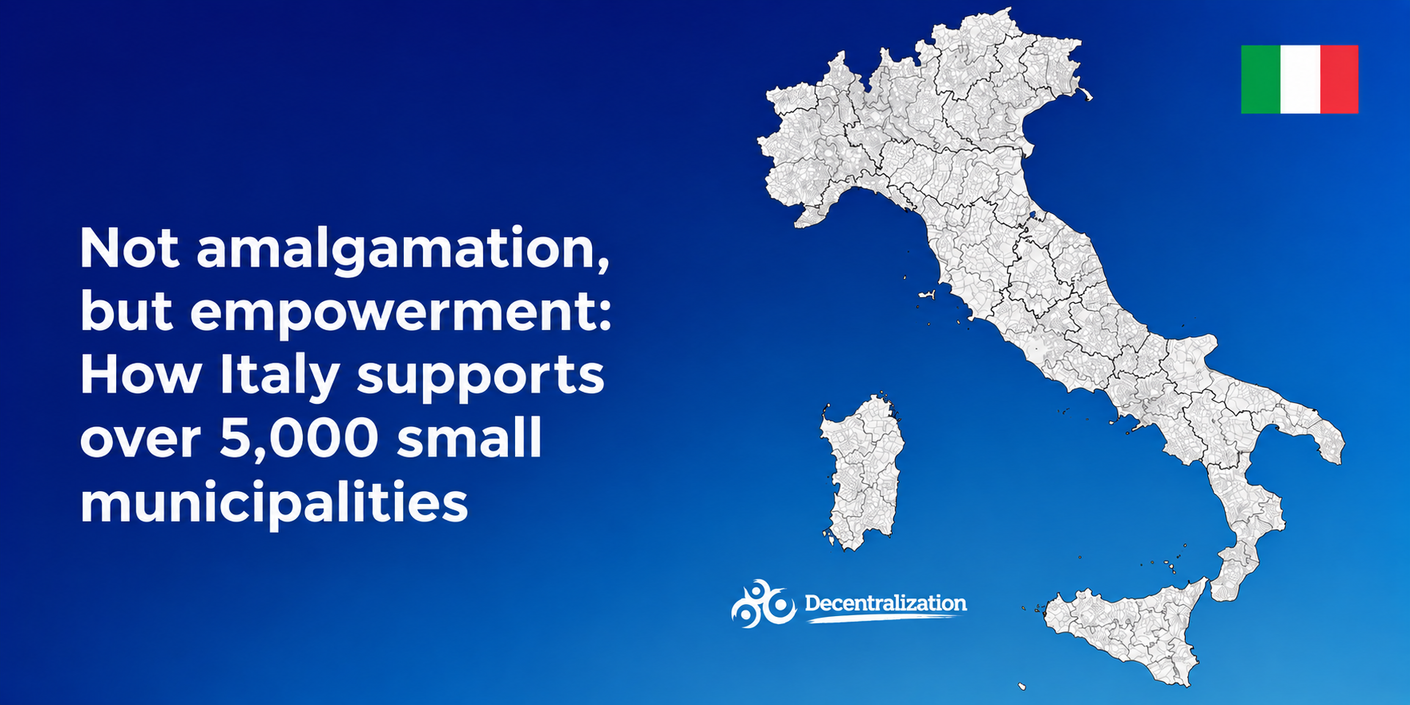
Support for small communities is provided through the following instruments:
- financial equalisation via the FSC;
- special development programmes for small Comuni;
- encouraging inter-municipal cooperation (joint performance of functions, establishment of joint services);
- recruitment of additional staff and capacity-building for local administrations.
This approach is based on the idea that the problem of small municipalities lies not only in the size of their territory or population, but in their ability to exercise their powers. Therefore, rather than abolishing small municipalities, Italy is investing in ensuring they have access to funding, professional staff, and shared administrative resources.
After the Apennines, let us continue to the Iberian Peninsula.
Portugal is adapting its financial system to the new role of municipalities within the framework of decentralisation
Portugal is continuing its decentralisation reform, focusing on the transfer of powers to municipalities with appropriate financial mechanisms and clear accountability for their implementation.
On 17 July 2026, the Parliament of Portugal published a decision to approve a regime for the exceptional and temporary application of certain financial rules for municipalities and inter-municipal bodies, in compliance with Law No. 73/2013 on local governments’ finances. The document provides for the adaptation of certain budgetary restrictions and procedures to the current operating conditions of local self-government.
The decision forms part of a wider process of reviewing the financial model for local governments, which is intended to strike a balance between greater autonomy for municipalities and financial accountability for the use of public resources. The Government of Portugal emphasises the need to strengthen the capacity of municipalities, metropolitan authorities, and inter-municipal associations to carry out the functions delegated to them within the framework of decentralisation.
In parallel, in June–July 2026, the Directorate-General for Local Authorities (DGAL) will continue to oversee the transfer of powers to the local level. The decentralisation system covers areas such as education, healthcare, social services, culture, transport, housing policy, and the management of certain state-owned facilities. The Fundo de Financiamento da Descentralização (FFD) – a fund through which resources are provided to enable municipalities to exercise their new powers – is in place to finance the devolved functions.
Support for the lowest level of local governance, the parishes (freguesias), remains a separate area. Through the Fundo de Financiamento das Freguesias (FFF), the state provides financial transfers to enable them to exercise their own functions.
The Portuguese experience shows that decentralisation does not end with the transfer of powers: the next stage involves establishing financial rules, allocating responsibilities, and creating the conditions under which local authorities have the practical capacity to perform new tasks.
We conclude this overview at this westernmost point of the European continent, as far away from Ukraine as it is possible to be.
We will continue to keep a close eye on developments in European local self-government in order to share with you interesting practices, solutions, and the experiences of municipalities from different EU countries.
In turn, please write to us which countries’ experiences of local self-government you would be most interested in learning about, and which European practices you would like to see covered in future overviews.

Tags:
European integration international experience
Source:
Портал "Децентралізація"

24 September 2026
У Києві відбувся Національний форум «Майбутнє, яке обираємо ми!»
У Києві відбувся Національний форум «Майбутнє,...
22 вересня у Києві відбувся Національний форум «Майбутнє, яке обираємо ми!», організований Швейцарсько-українським...
24 September 2026
From production potential to development...
The region’s economic development starts with the ability to recognise its strengths and external opportunities and...
24 September 2026
In Kharkiv, the Polaris and SALAR International...
On 21 September, the management and experts of the Polaris Programme “Supporting Multilevel Governance in Ukraine”...
23 September 2026
Медичне відновлення громад: проєкти, партнерства та можливості фінансування
Медичне відновлення громад: проєкти,...
30 вересня – 1 жовтня у Києві відбудеться конференція ReBuild Ukraine: Health & Rehabilitation 2026, присвячена...