EU accession negotiation Chapter 22: next steps in bringing Ukraine closer to EU

When Ukraine talks about joining the European Union, the conversation usually begins with big and important words. Choice. History. Values. Somewhat less often, it turns to screening, negotiating positions and the pace of progress. Regional policy is also discussed. But far less attention is paid to the place it occupies within the very architecture of the European Union and to the role it plays in accession negotiations. To how decisions on territorial development, funding, and responsibility flow through it.
This is precisely what Chapter 22 of the EU accession negotiations is about: regional policy and the coordination of structural instruments. The title itself is somewhat dry and easily overshadowed by louder topics. Yet the experience of other countries shows that this chapter has a way of catching up with you precisely when it seems that the most difficult part is already behind. Chapter 22 is not a test of elegant formulations. It is a test of a state’s internal readiness – of whether it can, from the first day of membership, manage a large-scale development policy in a systematic, effective and transparent way, without excessive external supervision.
In this respect, the EU is distinctly pragmatic. What matters is not what a country declares, but how its governance processes really function: who sets priorities, how projects emerge, how funds are allocated and who takes responsibility when things do not go according to the plan. The largest EU resources flow through this chapter, and this is exactly where mistakes are most costly.
Unlike many accession chapters, Chapter 22 is not primarily about transposing a large body of legislation. Its real difficulty lies in building the administrative, financial and territorial machinery capable of programming, managing, controlling and evaluating EU funds. This requires a stable chain of responsibility from central government to regions and municipalities, supported by credible data, qualified staff and procedures that can withstand political change, financial scrutiny and external audit.
Ukraine today finds itself in a situation no other EU candidate country has faced in recent decades. It is fighting a full-scale war of the highest intensity since the Second World War, while at the same time pursuing recovery, reforms and accession negotiations. In such circumstances, it is only natural to feel that regional policy can wait – that there are more urgent tasks now, and that balanced territorial development can be put in order after victory.
At the same time, the European logic of integration is based on the understanding that recovery, regional development and future membership are parts of a single process. The war is a serious and long-term constraint – and this is fully recognised by all partners. The question, therefore, is not whether to demand that the state operates under conditions that do not yet exist, but whether it can gradually build a clear and coherent system of decision-making and accountability already now. A system that, upon Ukraine’s accession to the European Union, will allow for a seamless transition to the full implementation of EU Cohesion Policy.
For Ukraine, this also means that the architecture of reconstruction and the architecture of accession should not develop as two parallel systems. The institutions, project pipelines, monitoring tools and accountability arrangements established for recovery should, wherever possible, be designed so that they can gradually evolve into the structures required for cohesion policy. Otherwise, Ukraine may later be forced to dismantle temporary mechanisms and rebuild them under the pressure of accession deadlines.
At this point, we come to an issue that is already high on the agenda of the Ukrainian authorities and the expert community, but is still often approached too narrowly. The Government of Ukraine has prepared and adopted the National Programme for the Adoption of the EU Acquis (NPAA). This is an important and necessary document. At the same time, by its nature, the NPAA primarily defines regulatory and legal measures. It sets out the changes required in legislation, while offering more limited guidance on how the system as a whole is expected to function in practice.
For the purposes of Chapter 22, this is not enough. Regulatory measures are a necessary but not sufficient condition. In this chapter, the logic of isolated decisions or standalone actions simply does not work. The EU assesses state capacity in a comprehensive manner. A weakness in any single element – be it project preparation, institutional architecture or monitoring systems – automatically calls into question the readiness of the entire mechanism. Administrative capacity is central to any success. Organisational charts and formal institutional designations are not sufficient. The EU will look for institutions that retain qualified staff, cooperate effectively across sectors, use compatible data and information systems, and take decisions within clearly established deadlines. In a policy area of this scale, capacity must be institutional and sustainable rather than dependent on a small number of experienced individuals.
This is why the need is becoming increasingly clear for a document that, in candidate countries, is typically referred to as a Chapter 22 Master Plan. This need does not arise from abstract theory, but from the actual practice of accession negotiations and the criteria the EU has applied to other candidate countries. Analysis of those countries’ negotiations under Chapter 22 shows that what mattered most to the EU was not the formal adoption of legislation, but the existence of a coherent and comprehensible system for implementing Cohesion Policy. In European practice, it was precisely this systemic coherence that determined whether a country was ready to move from candidate status to full membership. The NPAA alone, however, cannot ensure this. While it sets out the directions and commitments for alignment with the EU law, it does not answer the practical question of how these requirements are to come to life within institutions, procedures and day-to-day administrative decision-making.
The Master Plan should therefore be understood not as an additional strategy, but as a practical management instrument for accession. It should define the target system, identify the gap between current and required arrangements, sequence reforms, assign responsibility, establish measurable milestones and expose dependencies between different actions. Its value lies precisely in making visible what must happen first, what can proceed in parallel and what cannot be safely postponed.
A Master Plan is needed to translate the complex requirements of Chapter 22 into a practical logic of action: who takes decisions and at which level, how the project pipeline is formed, how national and regional priorities are aligned, and how the entire system is meant to operate not on paper, but in reality. The experience of other countries shows that the most serious problems arose precisely where this translation from EU requirements into practice did not occur. Not because of a lack of political will or missing legislation, but because of institutional disorientation – when there are many bodies but blurred responsibility; when strategies outnumber ready projects; when digital solutions exist in parallel but do not form a single, integrated system. For the EU, these are not minor technical shortcomings, but signals that the system is not yet ready to bear the full weight of Cohesion Policy.
Special attention should also be paid to how Ukraine already uses external and state resources today. For the EU, this is not merely financial assistance, but a form of stress test. Do procedures work? Are rules followed? Can the entire cycle – from idea to result – be traced? This is how readiness for much larger volumes of future funding is assessed.
In this sense, Chapter 22 is assessed early and quite strictly. Formally, it is opened later in the negotiation process, but in practice it begins to affect the pace of accession much earlier. Weak preparation here can slow the entire process, even where political support exists. The objective should not be to create a perfect system immediately, which would be unrealistic under wartime conditions. It should be to establish a credible sequence of decisions, demonstrate continuous implementation and progressively reduce institutional uncertainty.
The real risk is not that Ukraine will be denied EU membership. A far more dangerous scenario is slow, almost imperceptible slowdown. When negotiations continue, but key decisions are postponed. When funds are formally available, but trust is built more slowly than a country at war and in recovery can afford. In this sense, Chapter 22 is about the ability to look at one’s own state without illusions. About readiness to move from a collection of documents to a coherent system. About choosing between manual control and predictable rules.
In our view, Chapter 22 is one of the most important elements of Ukraine’s European integration. It is through the EU’s Structural and Investment Funds that resources flow, which allows countries to develop in a balanced way – through regions, communities and local economies. These are the funds for preparing territories and businesses for participation in the EU Single Market; for developing infrastructure, human capital, innovation, competitiveness, and addressing environmental challenges. How Ukraine prepares for this chapter will determine not only the pace of negotiations, but also whether EU membership becomes a genuine instrument of development rather than merely a political status. The sooner this understanding becomes part of the state’s strategic logic, the more predictable and mutually beneficial Ukraine’s integration into the European Union will be.
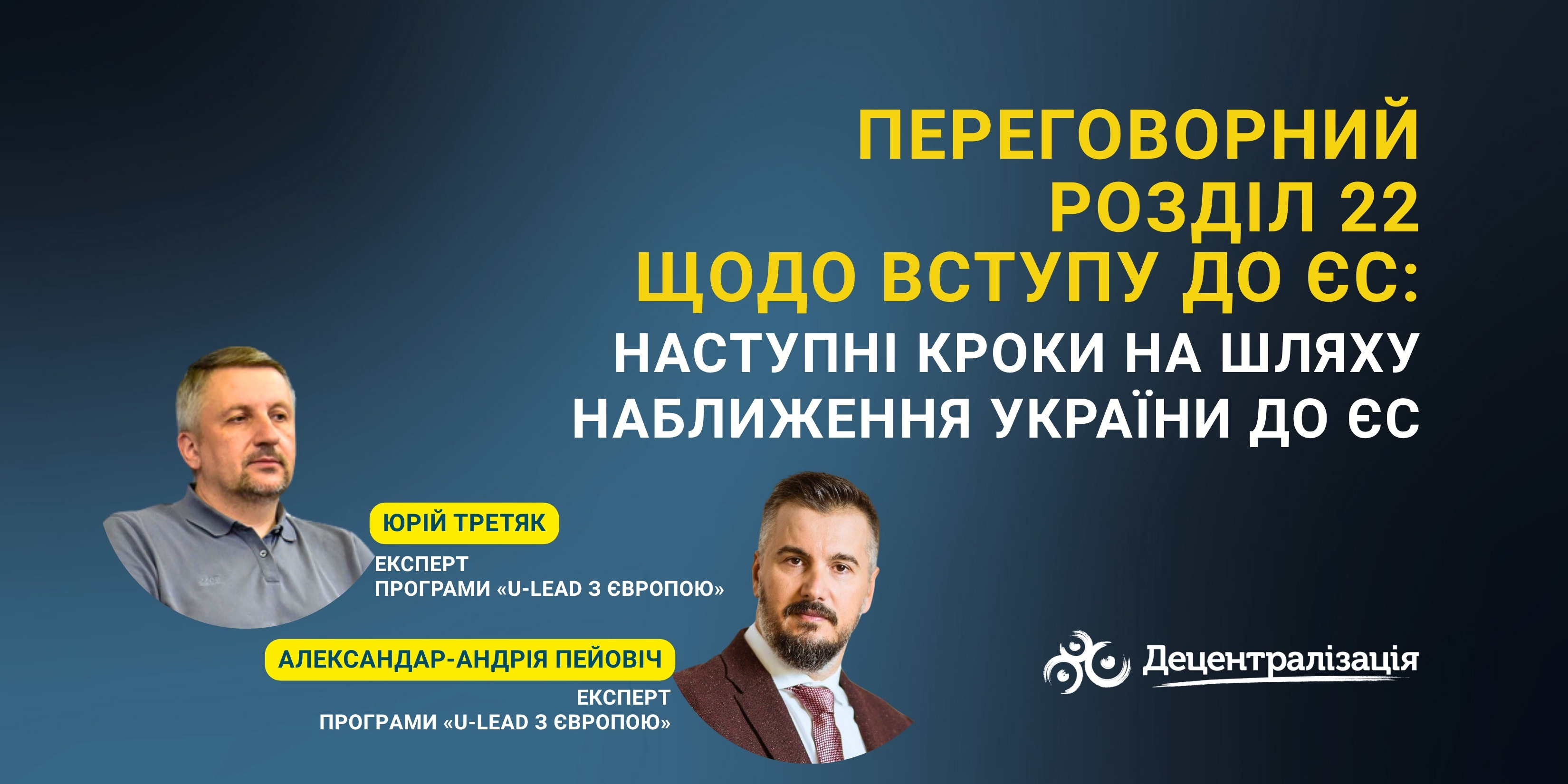
This article has been prepared by Yuri Tretyak and Aleksandar Andrija Pejović, in framework of U-LEAD with Europe support to Ukrainian authorities when preparing for EU accession negotiations. Its main intention is to support Ministry for Communities and Territories Development of Ukraine in meeting requirements of recommendations of the European Commission under Ukraine Enlargement Reports concerning Chapter 22 Regional Policy and Coordination of Structural Instruments. The contents of this article are the sole responsibility of its authors and do not necessarily represent the views of U-LEAD with Europe, the European Union and its member states Germany, Denmark, France, Austria, Poland and Slovenia.
***
Yuri Tretyak is a Ukrainian regional development expert with more than 25 years of experience in state regional policy, EU Cohesion Policy, decentralisation, public investment governance, and territorial recovery and development. He currently serves as Key Expert on Decentralisation and Regional Development within the U-LEAD with Europe Programme, supporting Ukraine’s alignment with Chapter 22 of the EU acquis and development of an EU-compliant Cohesion Policy system. Throughout his career, he has led and advised major EU-and donor-funded programmes, worked closely with national, regional, and local authorities, supported the development of regional strategies, institutional frameworks, investment mechanisms, and regional development agencies, contributed to Ukraine’s core regional policy legislation, and authored numerous publications on regional development, territorial governance, and European integration.
Aleksandar-Andrija Pejović is a former Minister of European Affairs, Chief Negotiator for Montenegro’s EU accession and National IPA Coordinator, with more than 26 years of experience in European integration, EU funds management and institutional reform. He has extensive expertise in programming, coordinating, monitoring and evaluating IPA assistance, linking EU financial support with accession priorities, Reform Agenda implementation and public administration capacity building. Currently, he is working with U-LEAD in preparing Ukrainian institutions involved in Chapter 22 EU accession negotiations, particularly in preparations of Chapter 22 Master Plan.

22 October 2026
III Міжнародний форум агломерацій в Україні: навіщо громадам діяти разом
III Міжнародний форум агломерацій в Україні:...
Транспортні маршрути, вода, критична інфраструктура та відбудова не зважають на адміністративні межі. Щоб громади...
22 October 2026
Олена Шуляк: громадам потрібно спільно...
Війна, внутрішня міграція та масштабна відбудова загострили питання, які не вкладаються в межі однієї громади. Про це...
22 October 2026
Віталій Безгін: агломераціям потрібні зміни до секторального законодавства
Віталій Безгін: агломераціям потрібні зміни до...
У Львові розпочався III Міжнародний форум агломерацій в Україні «Співпраця громад у функціональних територіях». У...
22 October 2026
У Львові розпочався III Міжнародний форум агломерацій в Україні (наживо)
У Львові розпочався III Міжнародний форум...
У Львові розпочався III Міжнародний форум агломерацій в Україні «Співпраця громад у функціональних...