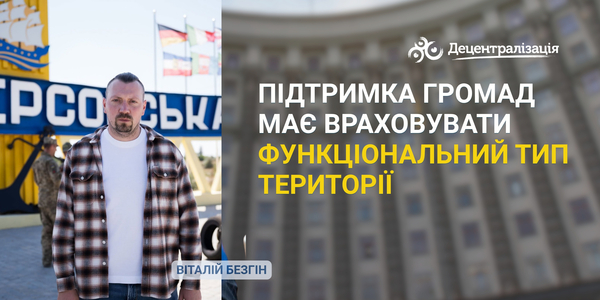
Vitalii Bezgin: Support for communities has to reflect the functional type of the territory
‘Ukrainian communities vary greatly in terms of security conditions, geography, the economy, and the needs of their people. Consequently, state support cannot be the same for everyone.’
This is how Vitalii Bezgin, Minister for Communities, Territories and Internally Displaced Persons of Ukraine, explained the Government’s decision to define functional types of territories and priorities for community development for each of them.
According to the Minister, this involves a shift to a more systematic and targeted approach in state regional policy. In the context of war and European integration, it is impossible to apply the same solutions to communities that face fundamentally different security, natural, economic, and social conditions.
‘It became clear even then that, in the context of full-scale aggression and, at the same time, active European integration, it is impossible to manage and compete in the same way, for example, with Kherson and Lviv,’ noted Vitalii Bezgin.
Work on this decision has continued since 2022, when the functional types of territories were enshrined in legislation. Members of Parliament, central executive bodies, local government associations, experts, and the civil society sector were all involved in the process. MinRehion systematised this work to transform the functional typology from a theoretical approach into a guideline for planning development.
What is set for communities
The amendments to the State Strategy of Regional Development for 2021–2027, which the Government approved on 17 September 2026, set out a list of communities categorised according to functional types of territory, along with their priorities for development.
The legislation defines four basic functional types of territories: territories of recovery, territories with special conditions of development, regional growth poles, and territories of sustainable development.
Within the category of territories with special conditions of development, the following are identified: territories with a low level of socio-economic development; territories with natural constraints on development; territories affected by man-made disasters; territories of fair transformation; nature conservation and rural territories. Territories with natural constraints include mountainous, forested, and steppe territories.
One community may be classified under several functional types. This is important: its needs will not be limited to a single characteristic, and it will be possible to combine different support instruments in the planning process.
For example, for 215 communities in territories of recovery, the priorities identified are security, demining, civil protection, the protection of critical infrastructure, the restoration of housing and services, employment, and economic activity.
For 85 mountainous communities, the priorities are the development of tourism, craft production, and organic agriculture; overcoming transport and digital isolation; natural hazard management; and the preservation of cultural heritage.
For 199 steppe communities, the priorities are water security, adaptation to climate change, sustainable land use, the conservation of steppe ecosystems, and the development of mobile and digital services.
For 232 rural communities: agricultural processing, co-operation, farming, basic infrastructure, access to services, employment and support for young people.
This approach helps to identify more clearly what specific solutions a particular territory needs and to design projects that address its real challenges.
‘The state regulates the forestry sector to a certain extent. But obviously, when we are talking about communities with typical landscapes on the one hand, and forested communities on the other, there need to be different, diversified approaches. The same applies, for example, to mountainous territories,’ explained the Minister.
Vitalii Bezgin gave the example of mountainous territories: whilst they offer opportunities for craft production, they also face logistical challenges, particularly for schoolchildren. Hence, government decisions have to take into account the full context of community life, rather than merely its administrative boundaries.
What this means for local self-government
The Government’s decision establishes an important framework for future state decisions. The priorities of functional types have to be taken into account when formulating state regional policy, development programmes, and public investment.
‘The next step in our decisions will be to create separate support packages for each individual functional type. This will help to reduce the development gap. It will also facilitate more pragmatic and systematic engagement with European programmes and funds. But the key is to bring services closer to each of our citizens,’ emphasised Vitalii Bezgin.
For communities, this means that they should start aligning their own development strategies, sectoral programmes and project portfolios with their functional profile right now.
For example, a steppe community could justify a water supply modernisation project not only on the basis of the need to repair networks, but also on its contribution to water security and climate resilience. For a mountainous community, the combination of transport accessibility, local economic development, tourism, and the protection of natural resources may be key. For a territory of recovery, the link between security, critical infrastructure, housing, employment, and the accessibility of services is crucial.
New indicators for monitoring
Amendments to the State Strategy of Regional Development also provide for the addition of two indicators to the monitoring system:
- a budget fiscal capacity index based on personal income tax revenue;
- the level of accessibility of physical environment facilities.
This should help to assess the financial capacity of territories and the accessibility of the environment for people more accurately. In other words, it means looking at community development not only in terms of the amount of funding or the number of facilities built, but also in terms of quality of life and the real capacity of the territory.
Vitalii Bezgin expressed the hope that, as early as 2027, support programmes of MinRehion will be systematised in line with the functional types of territories.
The Government’s decision is an important step in the development of a policy in which support for communities will depend not on a standardised template, but on the specific needs of the people, the security situation, natural conditions, and the economic potential of the territory.
The full text of the Resolution “On Amendments to the State Strategy of Regional Development for 2021–2027” had not yet been published on the Government portal at the time of writing.
Tags:
Vitalii Bezghin regional development
Source:
Портал "Децентралізація"
23 September 2026
Медичне відновлення громад: проєкти, партнерства та можливості фінансування
Медичне відновлення громад: проєкти,...
30 вересня – 1 жовтня у Києві відбудеться конференція ReBuild Ukraine: Health & Rehabilitation 2026, присвячена...
23 September 2026
Locally-led Recovery: Polaris Programme Announces 8 Partner Hromadas
Locally-led Recovery: Polaris Programme...
The Polaris Programme “Supporting Multi-level Governance in Ukraine” has announced the selection results for...
23 September 2026
Від реагування до готовності: що потрібно громадам для безпечного водопостачання під час криз
Від реагування до готовності: що потрібно...
Генератор, резервна свердловина чи запас реагентів самі по собі ще не означають, що громада готова до водної кризи....
22 September 2026
Capacity building and empowerment of local communities in Ukraine
Capacity building and empowerment of local...
This article of the U-LEAD series identifies the additional and strengthened capacities that Ukrainian local...