Capacity building and empowerment of local communities in Ukraine

This article of the U-LEAD series identifies the additional and strengthened capacities that Ukrainian local authorities will need in order to deliver reconstruction effectively and to progressively assume roles compatible with Cohesion Policy rules and instruments. More specifically, it lays out various capacity domains with the corresponding priority level and an overall capacity maturity ladder. It also underlines the role of EU-Ukraine partnerships at the subnational level and finally lists the viability conditions for the ITI and CLLD instruments described in the previous chapter to be effectively implemented in Ukraine.
From existing functions to Cohesion Policy relevant capacities
Ukrainian municipalities already perform many functions relevant to territorial development, including local development planning, medium-term investment planning, and infrastructure project preparation. The central question is therefore not one of role creation, but of capacity deepening and functional upgrading in light of reconstruction scale, Cohesion Policy logic, and the potential future use of integrated territorial instruments (e.g. ITI and CLLD – see again Chapter 3).
Reconstruction and EU alignment significantly expand the qualitative demands placed on local administrations:
- First, scale and complexity increase: municipalities are required to manage larger investment volumes, multiple financing sources, and more complex projects than before the full-scale invasion.
- Second, coordination requirements intensify: reconstruction and Cohesion Policy both require alignment across sectors, territories, and levels of government.
- Third, accountability expectations rise: EU-style funding frameworks place strong emphasis on transparency, monitoring, auditability, and performance.
These shifts create capacity gaps that go beyond traditional municipal functions. They concern not only staffing levels, but also analytical capabilities, coordination mechanisms, and professional cultures. Addressing these gaps is essential if local governments are to act as credible partners in a Cohesion Policy oriented system rather than passive project applicants.
The screening process of Chapter 22 in Ukraine points to limited evidence of project maturity, insufficient substantiation of investment pipelines, and the need to strengthen coordination and implementation capacity at subnational level. In operational terms, this means that local communities must move from preparing isolated projects towards managing integrated investment pipelines; from ad hoc coordination towards structured multi-level governance; and from compliance-oriented reporting towards basic performance management. These shifts do not require entirely new roles, but rather deeper professionalisation and stronger organisational routines.
Priority capacity domains for local communities
Distinction between high-priority and medium-priority capacity domains reflects a practical assessment about which capacities are most immediately critical for credible reconstruction delivery and for gradually introducing EU-compatible implementation discipline in the pre-accession period. High-priority domains are those where weaknesses can quickly undermine project feasibility, integrity or auditability. Medium-priority domains remain essential, but their effectiveness depends more on the prior existence of basic delivery discipline and administrative reliability.
The sequencing across the five domains follows a simple operational logic. Communities first need the capacity to identify, prioritise and manage credible investment pipelines and to implement them in a compliant and controllable way. On that basis, they can engage more effectively in inter-municipal cooperation, structured partnership management and, over time, more systematic monitoring and performance-oriented delivery. This sequencing should not be applied mechanically: the domains are interdependent, and for weaker or war-affected hromadas, inter-municipal cooperation may in practice be a precondition for building even basic delivery capacity.
Strategic integration and investment pipeline management (high priority)
The ability to translate local strategies into credible, prioritised investment pipelines is a core Cohesion Policy expectation. While many hromadas have strategies, the Screening Report points to the need for stronger coordination, transparency and evidence-based decision-making in programming, and it highlights that project pipeline maturity is not yet sufficiently substantiated through standardised readiness approaches. To address this gap, local communities need strengthened capacities to rank projects based on strategic relevance and territorial impact, assess readiness and risks, and sequence investments over time. This includes the capacity to:
- prioritise projects based on territorial impact and functional relevance, not only local urgency;
- assess project readiness and risks in a standardised way;
- bundle smaller projects into coherent investment packages;
- update pipelines dynamically as conditions change.
This capacity is particularly critical if Ukraine moves towards integrated territorial approaches. ITI-type instruments require local actors to coordinate multi-sector investments across functional areas, ensuring that individual projects reinforce each other and contribute to shared objectives. Without robust pipeline management, such instruments cannot function effectively.
Inter-municipal and functional-area cooperation (medium priority)
ITIs depend on effective cooperation across administrative boundaries. Ukrainian local governments have limited experience with structured inter-municipal cooperation. For local communities, this translates into a need to develop governance capacities beyond administrative boundaries. Inter-municipal cooperation must evolve from informal arrangements to structured mechanisms with clear decision-making, shared responsibilities and accountability. Future capacity needs therefore include:
- governance arrangements for joint decision-making;
- shared technical teams for project preparation and implementation;
- financial coordination mechanisms, including cost-sharing and joint procurement;
- dispute-resolution and accountability arrangements.
Operationally, this implies the ability to establish joint steering arrangements, pool technical expertise, manage joint procurement or implementation units, and agree on cost-sharing and benefit allocation. These capacities are prerequisites for ITI or CLLD-type tools and are equally relevant for efficient reconstruction delivery in areas such as utilities, transport and social infrastructure.
Partnership management and participatory governance (medium priority)
Cohesion Policy places strong emphasis on the partnership principle, requiring structured engagement with civil society, business actors, and other stakeholders. Many Ukrainian municipalities have experience with consultations, but less with institutionalised partnership management. Local communities therefore need to strengthen their capacity to:
- design participatory processes linked to concrete investment decisions;
- manage stakeholder expectations transparently;
- document how inputs are integrated into decisions;
- sustain partnerships over multi-annual programming cycles.
This capacity is particularly relevant for community-led instruments such as CLLD, where local authorities must act as facilitators rather than sole decision-makers. Even outside CLLD, structured partnership management enhances legitimacy and reduces implementation risks.
Procurement, compliance and internal control (high priority)
Reconstruction financing already exposes weaknesses in procurement, contract management, and internal control, with procurement and internal control weaknesses repeatedly highlighted in Enlargement Reports. Cohesion Policy would further raise compliance requirements. For local communities, this represents one of the most binding constraints on scaling reconstruction and future Cohesion Policy-type funding. Local authorities therefore need strengthened capacities in:
- procurement planning for complex, multi-lot projects;
- contract management and supervision;
- internal control and risk management;
- documentation and audit readiness.
Capacity development needs to go beyond formal compliance training and focus on procurement planning for complex projects, contract management, internal control routines and audit readiness. Given the diversity of hromadas, shared service models or regional support units will be essential to avoid excluding smaller or war-affected communities from investment opportunities and ensure that hromadas can meet standards without excessive administrative burden.
Monitoring, data use and basic performance management (medium priority)
Results-oriented funding requires the ability to define indicators, collect data, and use evidence for decision-making. Local governments will need to move beyond activity reporting towards basic performance management. Local communities must therefore strengthen their ability to define a limited set of indicators linked to investment pipelines, collect and validate data, and use monitoring results for decision-making, including analytical skills to interpret data and adjust interventions.
The emphasis should be on usability rather than sophistication. A pragmatic minimum step is to establish basic output/outcome tracking that is actually used in decisions, and to connect it to existing digital platforms (e.g. DREAM / geo-information tools) to support learning-by-doing during reconstruction.
Capacity maturity ladder for Ukrainian local communities
Given wide territorial disparities, capacity development should follow a differentiated maturity ladder rather than uniform standards.
- At a basic level, communities must be able to maintain essential administrative continuity, prepare a minimal prioritised investment list, comply with procurement rules and report on implementation.
- At an intermediate level, communities should manage coherent investment pipelines, participate in structured multi-level coordination, apply standard monitoring routines and engage stakeholders systematically.
- At an advanced level, communities can act as lead or core partners in integrated territorial instruments, manage functional area cooperation, and contribute substantively to programming and evaluation processes.
This ladder provides a practical tool for sequencing reforms and targeting support, taking into account uneven administrative capacity.
The role of EU-Ukraine municipal and regional partnerships
Partnerships between Ukrainian and EU municipalities and regions can serve as a practical capacity building instrument and can accelerate movement along the capacity maturity ladder. Beyond symbolic twinning, such partnerships should be task-oriented and linked to concrete reconstruction or development challenges. Partnerships can support:
- peer learning on integrated territorial approaches;
- transfer of operational know-how on ITI/CLLD design and management;
- mentoring on procurement, monitoring, and partnership governance;
- exposure to EU administrative routines and professional standards.
To be effective, these partnerships should be time-bound and linked to concrete reconstruction or development objectives rather than generic exchanges. They can transfer tacit knowledge that formal training cannot provide. Aligning these partnerships with priority capacity gaps identified above would maximise their contribution to Chapter 22 readiness.
Minimum viability conditions for ITI/ CLLD-type instruments in Ukraine
In the Ukrainian context, ITI-type instruments should be understood primarily as tools for functional-area cooperation, where several communities or territories need to coordinate investments around shared development challenges, infrastructure systems or service linkages. CLLD, by contrast, should be framed more flexibly as a local partnership-based approach centred on participatory governance and bottom-up initiative. Depending on the territorial context, such partnerships may operate within a single community or may extend across several communities where this is justified by common needs and local cooperation patterns. This distinction is important in order to avoid treating the two instruments as institutionally identical and to ensure that piloting reflects their different governance and capacity implications.
For ITI or CLLD-type instruments to be viable in the Ukrainian context, several minimum conditions must be met at local and functional-area level.
- First, there must be a clearly defined functional territory with shared development challenges and political willingness to cooperate.
- Second, participating communities must agree on a joint governance structure with defined roles and decision-making rules.
- Third, a consolidated investment pipeline aligned with a common strategy is required.
- Fourth, basic administrative capacity for procurement, monitoring and reporting must be ensured, either locally or through shared services.
- Finally, mechanisms for stakeholder participation and accountability must be in place.
These conditions suggest that ITI and CLLD should initially be piloted in selected, higher-capacity territories, with gradual expansion as capacities mature. Local communities, operating within this framework, become effective delivery partners: implementing reconstruction and development investments, progressively assuming more complex roles as capacities mature, and feeding territorial intelligence back into the regional development steering system. This sequencing ensures that reconstruction delivery builds the institutional and administrative foundations required for Cohesion Policy implementation, while avoiding parallel systems or disruptive institutional jumps in the pre-accession phase.
The full list of sources used is available for download HERE
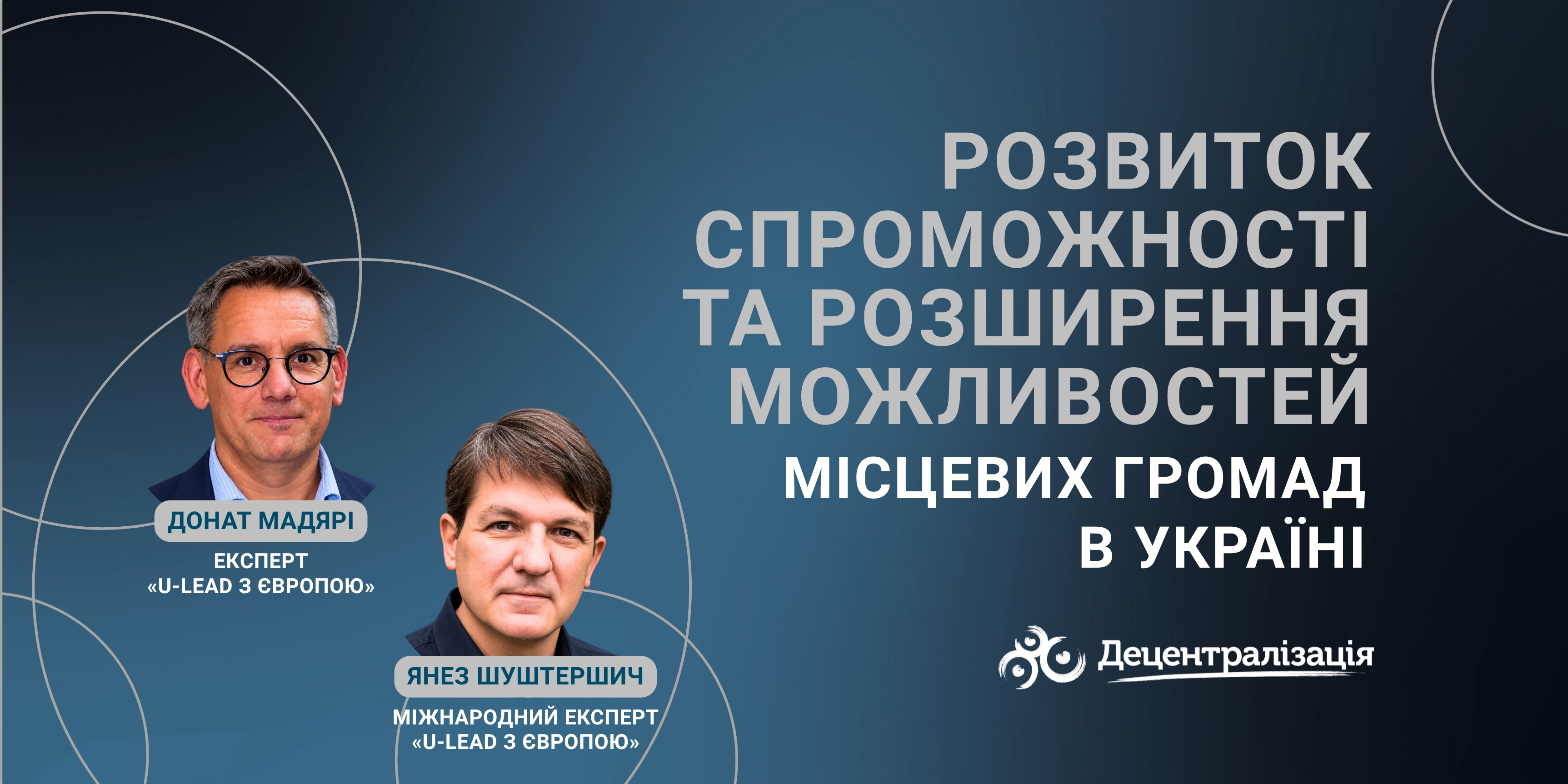
This article was prepared by Donat Magyari and Janez Šušteršič for the Vienna Institute for International Economic Studies (wiiw) within the project “Support to the Decentralisation Reform in Ukraine”, supported by U-LEAD with Europe. It is derived from the Strategic Paper “Strategic vision of regional development policy: short-term and mid-term recommendations for Ukraine’s alignment with Chapter 22 of the EU acquis”, which aims to support Ukrainian policy-makers in designing and implementing a robust regional development policy in line with EU rules and practices. The article contributes to this objective by outlining a strategic vision for Ukraine’s regional development policy, with particular relevance to Chapter 22: Regional Policy and Coordination of Structural Instruments and future EU Cohesion Policy implementation.
The views expressed in this article are those of two authors and do not necessarily reflect the views of wiiw, U-LEAD with Europe, the European Union or its Member States Germany, Denmark, France, Austria, Poland and Slovenia.
Donat Magyari is an independent development economist and U-LEAD expert with 30 years of professional experience, specialising in digitalisation, disruptive and user-driven ICT innovation, and technology-enabled development. He has worked with leading technology companies and contributed to European initiatives including the Intelligent Cities Challenge, European Digital Innovation Hubs, the European Green Deal and the Digital Europe Programme. He also served on the Advisory Board of the EU-funded “Modelling the European Data Economy” initiative and, since 2010, has continuously supported the European Commission as an external evaluator of projects in open innovation, Smart and Digital Cities, the Internet of Things, Intelligent Transport Systems and location-based services.
Janez Šušteršič is a former Minister of Finance of Slovenia and an international expert for U-LEAD with Europe. Since 2013, he has worked in technical assistance projects focusing on the strategic policy level, he supported preparation of economic reform programmes and development strategies, as well as coordination between policy strategies, fiscal frameworks and the EU integration agenda. During the last three years, he has worked for the OECD as an external expert on monitoring and evaluation of SME development strategies in the Eastern Partnership countries, including Ukraine.
Next article of the U-LEAD series: “Coordination of policy interventions” by Janez Šušteršič and Donat Magyari. It will explore how Ukraine can strengthen whole-of-government coordination and strategic planning and further develop the Public Investment Management (PIM) system and the State Fund for Regional Development (SFRD) to better align regional and local investments with reconstruction priorities, Chapter 22 requirements and future EU Cohesion Policy implementation.

Author: Donat Magyari
Attached files:
Tags:
22 September 2026
Polaris Programme Selects 13 Rural Hromadas for Cooperation to Strengthen the Starosta Institution
Polaris Programme Selects 13 Rural Hromadas for...
Following the Open Call, 13 rural hromadas from 8 oblasts of Ukraine were selected for cooperation with the...
22 September 2026
Жити містом, а не долати його. Як безбар’єрний...
Безбар’єрність міського простору починається з конкретних рішень, які дають людям більше самостійності у щоденному...
22 September 2026
Tender: Support to preparation of Development...
The Polaris Programme: Support to Multi-Level Governance in Ukraine invites eligible tenderers to submit...
22 September 2026
У Стрию відбудеться регіональний форум «Доброчесність у громаді: від принципів до практичних дій»
У Стрию відбудеться регіональний форум...
Як перейти від реагування на корупційні ризики до системного формування культури доброчесності в громадах? 29...