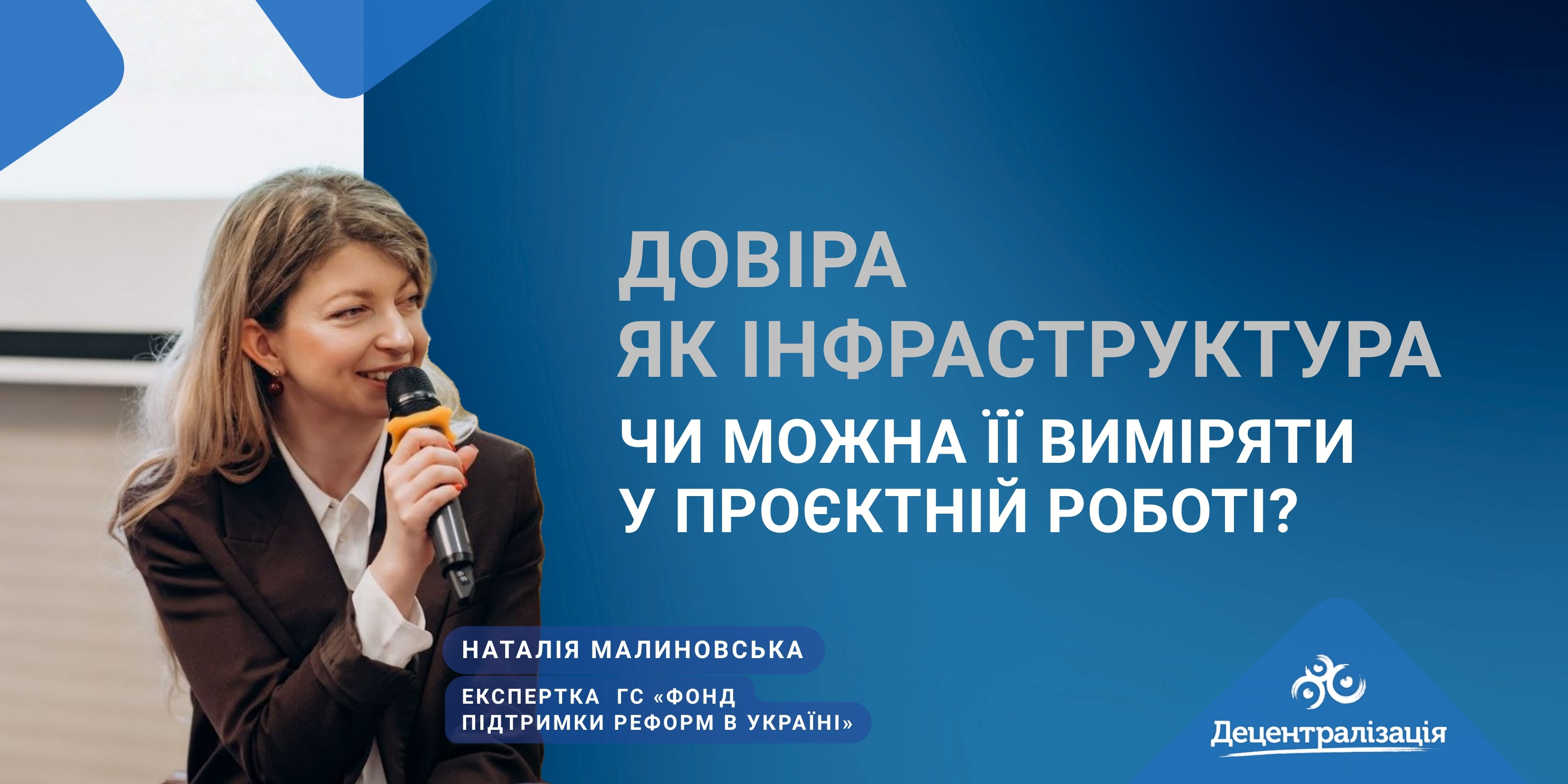
Expert of NGO Foundation for Support of Reforms in Ukraine
In times of uncertainty, the importance of trust grows. It often remains the invisible link that brings together people who were previously strangers, enabling them to reach agreements, make commitments, and act together even when the outcome is uncertain. When we talk about cooperation, about the relationship between the authorities and residents, about partnerships between organisations, and about recovery and reconstruction, we are in fact talking about what enables different stakeholders to move in the same direction. Often, this bond is trust, although we do not always notice it, measure it or even fully understand how it works.
When we feel unwell, we take our temperature or blood pressure, and if necessary, we see a doctor or take medication. But if a previous experience with a doctor was unsatisfactory, we might look for another specialist or simply take the medication straight away for a quick result. In other words, our next steps depend not only on our needs, but also on the experiences we draw upon.
When a project fails to deliver the expected results, we analyse the indicators, the tasks completed, or the resources spent. But when it comes to trust, we often limit ourselves to stating that it is important for a partnership, or that it should be built by the end of the project. However, holding a meeting, signing a memorandum, or involving people in consultations does not in itself mean that trust has been built. Participation in itself does not equate to trust. What matters is what happens after the project: whether participants were listened to, whether decisions were explained, whether agreements were fulfilled, and whether there is a desire to continue the cooperation. I therefore suggest looking at trust more broadly – considering what it actually entails in projects and whether we “lose” it in project indicators.
In its study on trust, the Organisation for Economic Co-operation and Development (OECD) shows that changes in trust in the national government are more closely linked to how people assess the handling of complex and long-term decisions than to their everyday experience of interacting with institutions. Of particular importance are perceptions of the reliability of institutions, their ability to respond to people’s needs, and the fairness of the decisions taken (Source: OECD, Survey on Drivers of Trust in Public Institutions 2026 Results. URL: https://www.oecd.org/en/publications/oecd-survey-on-drivers-of-trust-in-public-institutions-2026-results_9eb63fec-en.html) This is an important reminder that trust is built not only through friendly communication or well-organised meetings, but also through the way decisions are made, whether different interests are taken into account, and whether participants can rely on the agreements reached.
For local self-government, where trust is built not only during crises or political events, but also through everyday interactions, when people approach local authorities, take part in consultations, or try to influence decisions that affect their community. However, the mere opportunity to express one’s opinion does not in itself guarantee trust. Trust arises when people see how their suggestions have influenced decisions and whether they can rely on the agreements reached.
Looking back at the OECD study, in the countries covered by the survey, 46% of respondents expressed high or moderately high trust in local authorities, compared with 40% for the national government. At the same time, only 39% believe that participation in public consultations has a noticeable impact on government action (Source: OECD, Survey on Drivers of Trust in Public Institutions 2026 Results. URL: https://www.oecd.org/en/publications/oecd-survey-on-drivers-of-trust-in-public-institutions-2026-results_9eb63fec-en.html). In this regard, it is worth considering what constitutes the outcome of participation. One can hold public hearings, discussions, or public consultations, and count the number of participants and recommendations made. However, if citizens do not understand what has happened to their proposals – why some have been taken on board and others have not – the engagement process itself will not necessarily strengthen trust. Sometimes it may, on the contrary, increase disappointment. Therefore, when organising events, organisers bear a dual responsibility. The first is directly during the event, creating conditions in which the participants can express themselves freely, be heard, and understand how the discussion and decision-making take place. The second is after the event has concluded: to explain what outcomes have been achieved, how they will be used, what suggestions were taken into account, and which were not, and why.
At the level of an individual project, this means that it is worth looking not only at the activities performed and the results achieved, but also at how the interaction between its participants is changing:
- Do the partners share information, particularly on problems and risks?
- Do they fulfil agreements without constant external monitoring?
- Are they prepared to invest their own resources, take responsibility, and approach one another with new proposals?
- Do they continue to cooperate when funding, mentoring, or coordination from the project team ends?
This list of questions can be extended. The answers to these questions will not provide a definitive answer as to whether partners trust one another. For example, co-funding a project may stem not only from trust, but also from economic interests or formal obligations.
In the InConnect project, the two teams raised over UAH 950,000 in co-funding from business partners. This figure can be seen as one behavioural indicator that businesses were prepared to invest their own resources in joint projects, and that the partnership went beyond mere participation in events or declarations of cooperation. To understand whether this also indicated a growth in trust, it is worth examining whether co-funding was a mandatory condition for receiving a sub-grant to implement the project, or whether it was agreed upon when the memorandum of cooperation was signed.
Here, in my view, is where the scope for practically measuring trust arises. At the start of the project, records can be kept of how participants assess their cooperation, the extent to which they are prepared to rely on one another, and what they expect from their partners. Throughout the project, we can refer back to these questions, monitor how agreements are fulfilled and observe reactions to challenging situations. And upon completion, assess what remains between the participants, apart from the report and the activities undertaken. This leads to the question of how to make trust an integral part of project planning and evaluation. For example, right at the start of the project, one can identify which changes in the interaction between partners will indicate growing trust, and then, throughout the project, look back at these indicators to check whether anything is actually changing. To do this, it is important to combine different evaluation methods, such as interviewing participants about their experience of cooperation, observing how agreements are implemented, and analysing changes in the partners’ willingness to take on responsibility or continue working together. In this way, trust will cease to be merely a backdrop or a quantitative indicator, and will instead become one of the metrics to which the team pays systematic and conscious attention throughout the project’s implementation.
In recovery and reconstruction, where communities, public authorities, civil society organisations, businesses, and international partners have to work together, trust is important not just for completing a specific project. It determines whether the next joint effort will be easier, or whether we will have to start from scratch each time, renegotiating the rules and testing each other’s intentions. Trust should therefore be viewed not only as a necessary condition for cooperation, but also as an outcome that we can consciously monitor and which can form the basis for the next project.
Trust does not necessarily have to be measured by a single indicator, nor should we assume that every joint project will inevitably strengthen it. It is important to identify which changes in our interaction will indicate that trust is developing, and which may suggest that it is lacking. This is exactly what it means to bring trust to the fore – rather than assuming it will arise by default between partners as a result of the project.
Trust is often overlooked as an intangible component of a project, although in reality it forms part of the infrastructure of joint work, acting as a bridge between its participants. However, we will only be able to talk about trust when we stop glossing over partnerships that have failed due to a lack of it, and start asking what aspects of our work provide grounds for saying that trust has emerged. The outcome of a project is not only what can be quantified in a report, but also the experience of cooperation that makes the next joint action possible.
The column reflects the opinion of its author only. The author is responsible for ensuring the accuracy of the information. The views expressed in the column may not coincide with those of the editorial staff of the Decentralisation Portal.

07 November 2026
From community resilience to European...
The European Commission recognises the resilience of Ukrainian local self-government in the face of full-scale war,...
06 November 2026
IDPs can choose their new community before evacuation: MinRehion develops new digital service
IDPs can choose their new community before...
A person forced to flee a dangerous territory needs to know, even before evacuation, where they will be able to live...
06 November 2026
Мінфін у жовтні забезпечив перерахування з...
У жовтні 2026 року Мінфін згідно з бюджетним законодавством забезпечив перерахування міжбюджетних трансфертів до...
06 November 2026
Громади можуть залучити до 100 000 євро на...
Литовський фонд співробітництва з розвитку та гуманітарної допомоги оголосив конкурс проєктів міжнародного...