From community resilience to European standards: How EC assesses Ukraine’s decentralisation and regional policy
The European Commission recognises the resilience of Ukrainian local self-government in the face of full-scale war, positive changes in legislation, the development of administrative services, and improvements to the public investment management system. However, the 2026 Annual Ukraine Report sets out the objectives for the next phase of decentralisation and the preparation of regional policy to operate in line with EU rules. Among the priorities are the delineation of powers, ensuring the financial autonomy of communities, the development of strategic planning, and creating the conditions for the future use of EU cohesion policy instruments.
On 4 November, the European Commission published the annual Ukraine 2026 Report, covering the period from 1 September 2025 to 1 September 2026. The document is part of the EU enlargement package and contains an assessment of Ukraine’s progress towards accession, particularly in such areas as the functioning of democratic institutions, public administration, public finances, and regional policy.
The question of decentralisation and local self-government is addressed in several sections of the report, whereas regional policy is the subject of a separate Chapter 22 “Regional Policy and Coordination of Structural Instruments”. Taken together, these assessments provide an insight not only into the results of reforms already implemented, but also into the changes required for the further development of multi-level governance and Ukraine’s preparation for the application of European mechanisms for financing territorial development.
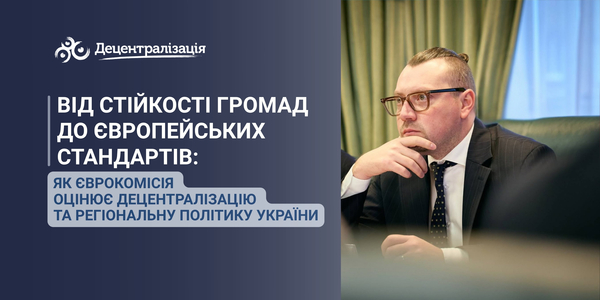
Minister for Communities, Territories and Internally Displaced Persons of Ukraine Vitalii Bezgin emphasises that it is important to view the European Commission’s conclusions as an assessment of the progress made so far and as a guide for the next stage of reforms.
‘It is important to us that the European Commission recognises the resilience of Ukrainian local self-government in the face of a full-scale war. This is an assessment not only of the reform, but also of the daily work of thousands of people in communities who ensure the functioning of their territories, provide services, support people, and find solutions in extremely difficult circumstances. At the same time, we view this report as a guide for the next stage of reforms. Ukraine already has experience of decentralisation to rely on, but accession to the European Union requires further improvements to the system of governance. Our task is not simply to implement the EC recommendations, but to ensure that these changes strengthen the capacity of communities, the quality of public services, and opportunities for regional development,’ the Minister noted.
Decentralisation: Resilience of the system and the next stage of the reform
One of the EC key findings is the recognition that Ukraine’s system of multi-level governance is capable of functioning effectively during a full-scale war. The report explicitly states that this system continues to operate in the face of russian aggression, and that the decentralisation reform should continue to focus on strengthening the capacity of local self-government in line with the requirements for EU accession and the European Charter of Local Self-Government.
One of the positive developments highlighted by the European Commission is the adoption of a law aimed to ensure the legality and transparency of local government activities. The document describes this step as a significant achievement in enhancing the effectiveness and transparency of multi-level governance. However, the further implementation of these principles will require the reform of local state administrations in line with a prefectural-style oversight model, which aims to ensure the legality of local government activities without compromising their autonomy.
The adoption of the updated Concept for Local Self-Government Reform in 2025 has also been positively assessed. The next step should be the approval of a comprehensive implementation plan with the specification of legislative changes, timelines, responsible parties and tasks from the previous plan for 2024–2027 that still need to be implemented. Thus, the European Commission views the continuation of decentralisation as a gradual process in which strategic decisions that have already been taken should be underpinned by specific legislative and organisational measures.
The delineation of powers between the state and local self-government occupies an important place among the tasks ahead. The European Commission notes progress in the preparatory work to define the relevant principles and criteria, in particular regarding the delieation of sectoral powers between sub-national levels of authority. Meanwhile, the relevant draft legislation has yet to be adopted, and its provisions have yet to be consistently incorporated into sectoral legislation. The report emphasises a fundamental requirement: powers have to be delineated between levels of authority, rather than between individual authorities, with local autonomy being preserved.
The European Commission pays particular attention to the financial foundations of local self-government. The report notes that the share of personal income tax allocated to local budgets remains at 64%. However, it recommends improving the legislative framework to establish a reliable mechanism for guaranteeing the financial autonomy of local self-government. This means that the focus is not only on the current parameters for the distribution of tax revenues, but also on long-term legal guarantees of the financial independence of communities.
Another issue that requires legislative regulation is the restoration of local self-gvernment once martial law has been lifted. The European Commission draws attention to the increase in the number of local military administrations and the need to define, in good time, the mechanisms for a return to the normal functioning of local self-government. The relevant legislation should provide for guarantees of local autonomy and the gradual termination of the activities of military administrations in de-occupied territories.
Commenting on these areas, Vitalii Bezgin stresses the interconnection between the powers, resources, and responsibilities of local governments.
‘Decentralisation does not end with the creation of capable communities. The next stage involves establishing clear rules for interaction between the state and local self-government. We need to definitively establish who is responsible for what, ensure adequate financial guarantees for the exercise of powers, and establish an effective system for overseeing the legality of decisions made by local governments without interfering with their autonomy. These are interrelated tasks. A community cannot be held accountable for a service without being provided with the appropriate powers and resources. Similarly, state oversight has to guarantee legality, rather than becoming a tool for administrative influence. Such principles have to guide the further development of local self-government in line with the European Charter and EU standards,’ the Minister emphasised.
Digitisation and administrative services: Ukraine among the world leaders
One of Ukraine’s most notable achievements, recognised in the EC report, is the development of digital governance and the system for delivering public services. The European Commission notes that Ukraine has become one of the world leaders in digitisation, as evidenced by its ranking on the UN E-Government Development Index (EGDI). In particular, Ukraine ranked first in the world on the e-Participation Index and fifth on the e-Services Index – two components of the international assessment of e-government development.
The European Commission highlights the role of the Diya platform, which remains the most widely used digital platform for the delivery of public services in Ukraine. Its operation has taken on particular significance during the full-scale war, when digital services help ensure citizens’ uninterrupted access to public services even under challenging security conditions. Meanwhile, digitisation covers not only administrative services but also tools enabling residents to participate in resolving local issues.
The European Commission makes a specific mention of the e-DEM e-democracy platform, which enables users to submit local petitions and take part in participatory budgeting and public consultations. According to the report, 500 communities, or 35% of the total, and 2.2 million people use the platform. This demonstrates the growing use of digital mechanisms for interaction between local governments and community residents.
In parallel with the development of online services, Ukraine continues to expand its physical network of access points for administrative services. At the start of 2026, there were 5,763 operational access points, compared with 4,886 in 2025. The network thus grew by 877 access points during the year. The European Commission also recognises the results of efforts to ensure accessibility: in 2026, 87% of administrative service centres were accessible to people with disabilities and those with reduced mobility. To further improve accessibility, guidelines have been developed for assessing ASC buildings.
These results are important for communities, as residents interact directly with the public services system at the local level. Combining digital services with an extensive network of Administrative Service Centres offers different ways of accessing services, depending on people’s needs and circumstances. Meanwhile, the European Commission has set out the following priorities: finalising the alignment of digital administrative procedures with the Law on administrative procedure, adopting legislation on digital accessibility, providing further training for officials, and passing the Law on Administrative Fees.
‘Ukraine’s first place in the world in the e-participation index, fifth place in the online services index, and the expansion of the network of Administrative Service Centres even during a full-scale war – these are results achieved through the systematic work of the state and local governments. But for me, equally important is the fact that behind these indicators lie very real opportunities for people: to access the services they need without wasting time, to influence decisions in their community, and to have access to public services regardless of where they live. Here, it is essential that digitalisation does not create a new divide between those who know how to use e-services and those who find it more convenient to visit the ASC. Therefore, we have to develop both approaches, ensuring the accessibility and quality of services for everyone,’ emphasised Vitalii Bezgin, Minister for Communities, Territories and Internally Displaced Persons of Ukraine.
Public administration and public investment: Reform results and new opportunities for communities
With regard to public administration reform, the European Commission notes that Ukraine has made good progress. Key achievements include the adoption of strategies for reforming public administration and public finance management for 2026–2030, the development of digital services, improvements to human resources management systems, and further alignment of legislation with the Law on administrative procedure. However, the European Commission emphasises the need to strengthen the coordination of reforms, improve public policy formulation, and reinforce the link between strategic planning and budgeting.
For the local level, the progress made in developing the network of administrative service centres is significant. According to the report, at the start of 2026, the network comprised 5,763 operational service access points, compared with 4,886 in 2025. At the same time, 87% of these centres were accessible to people with disabilities and those with reduced mobility. The European Commission also highlights the development of e-democracy: the e-DEM platform, which provides tools for local petitions, participatory budgeting and public consultations, is used by 500 communities, or 35% of the total, and 2.2 million people.
The further development of the administrative services system, in line with the EC recommendations, will require the completion of the alignment of digital procedures with the Law on administrative procedure, the expansion of training for officials, especially at the local level, and the adoption of the Law on administrative charges. These tasks are important for ensuring uniform standards for the provision of services regardless of a person’s place of residence and for further improving the quality of citizens’ interactions with the state and local self-government.
Public investment management reform has received a separate positive assessment. The European Commission notes the adoption of the Medium-Term Plan for Priority Public Investments for 2027–2029 and the Unified Project Portfolio for the Implementation of State Public Investments for 2027. At the same time, progress has been made in preparing medium-term plans and unified project portfolios at regional and local levels, indicating the gradual spread of new approaches to investment planning across the entire public administration system.
The following tasks relate to improving methodologies for evaluating and prioritising investment projects, updating sectoral strategies, and establishing a comprehensive national strategic planning system. The integration of the DREAM digital ecosystem with other information systems for managing public investment remains an important technological priority. For communities, this means placing greater emphasis on the quality of project preparation, ensuring projects align with regional strategic priorities, and ensuring that investment decisions are well-founded.
Regional policy: From national development mechanisms to EU cohesion policy
The report devotes particular attention to Chapter 22 “Regional Policy and Coordination of Structural Instruments”. According to the EC assessment, Ukraine has achieved a certain level of preparedness in this area, but progress during the reporting period was limited. Among the positive developments noted are the resumption of the work of the Interdepartmental Coordination Commission on Regional Development and the promotion of territorial cooperation programmes with EU Member States. However, some of the recommendations from the previous year remain relevant and require further implementation.
The assessment of ‘a certain level of preparedness’ corresponds to the second of five levels on the scale used by the European Commission to determine the readiness of candidate countries in each chapter of the accession negotiations. The Ministry considers this result to be a sound foundation for further work: the Law on the principles of state regional policy, the State Strategy for Regional Development, and the funding mechanisms through the State Fund of Regional Development are already functioning, and the task now is to ensure their full implementation. The aim for next year is to implement the key recommendations of Chapter 22 and raise Ukraine’s level of preparedness in this area.
This approach to assessment is linked to the content of Chapter 22 itself. It covers not only the development of the current system of state regional policy, but also Ukraine’s preparation for the future use of EU cohesion policy instruments. This policy aims to reduce disparities between regions and to support sustainable and inclusive socio-economic development. Its implementation involves multi-annual programming, partnership and shared management between the European Commission and the Member States, as well as effective systems for financial management, control, and evaluation of results.
The European Commission stresses the need for the full implementation of the Law “On the Principles of State Regional Policy”. In particular, this involves clarifying the content and structure of strategic planning documents at the local level, digitising them, and ensuring they are linked to financial resources. An important component of preparations for the EU cohesion policy should be the establishment of a coordinated system in which strategic objectives for territorial development will determine the priorities for investment and the corresponding funding programmes.
A separate section of the report is devoted to the State Fund of Regional Development. The European Commission notes the adoption of regulatory provisions concerning the State Fund of Regional Development for 2026 and 2027, but also highlights the need for further improvement of the Fund’s regulatory framework, the methodology for allocating funds, and the mechanisms for implementing projects. Other priorities include completing the digitalisation of the State Fund of Regional Development and bringing it further into line with the principles of EU cohesion policy, particularly in terms of transparent project selection, stable multi-annual planning, and the alignment of funding with strategic priorities.
In a broader context, this involves developing funding mechanisms that will enable the needs of regions to be linked to the long-term objectives of state regional policy and ensure consistency in investment decisions. This logic is crucial for the future application of EU cohesion policy instruments, where programme funding is directly linked to defined priorities, expected outcomes, and monitoring systems.
Capacity of regions and communities: Preparation for future EU programmes
The European Commission identifies the development of an institutional framework for the future planning and implementation of cohesion policy as one of the key areas for further work. This involves designating programme management bodies, intermediate bodies where appropriate, and audit bodies, as well as strengthening inter-ministerial coordination. The report emphasises the need to strengthen the capacity of the central executive body responsible for regional policy to ensure coordination between different sectors and levels of governance.
However, preparations for future EU programmes will require the development of human resource capacity at national, regional, and local levels. The European Commission highlights the need for professional training, adequate remuneration, and the retention of qualified specialists capable of preparing projects, conducting public procurement, managing programmes, and monitoring, evaluating, and exercising financial control. An important component of this process should also be the systematic involvement of regional and local governments, civil society and other stakeholders in the formulation and implementation of regional policy.
The European Commission also stresses the need to further improve financial management, internal control and audit systems. To ensure the effective management of EU funds in the future, reliable accounting, reporting and traceability mechanisms for the use of funding need to be established. Separately, the importance of developing integrity tools at the local level and further improving DREAM as a tool for transparency and the prevention of corruption has been highlighted.
Commenting on the prospects for the development of regional policy, Vitalii Bezgin points out that preparations for European funding instruments have to encompass the entire public administration system, rather than being limited to individual institutional changes.
‘In terms of regional policy, we face a challenge that goes far beyond simply updating strategies or improving individual funding mechanisms. We need to prepare the system to work with the European Union’s cohesion policy instruments. This entails a different culture of planning, investment management, partnership, accountability for results, and the use of public funds. It is of fundamental importance to us that regions and communities are full participants in these processes. European integration should create new development opportunities for territories, rather than additional bureaucracy. Therefore, alongside legislative and institutional changes, it is necessary to invest in the capacity of local teams who will directly prepare and implement projects. Our ability to make effective use of the future opportunities offered by EU membership will depend on how well we do this preparatory work,’ the Minister noted.
Based on the assessment results set out in Chapter 22, the European Commission has identified three main sets of priorities for the coming year.
The second group of recommendations relates to strategic planning and the financing of regional development. The European Commission expects improvements in reporting on the implementation of the current State Strategy of Regional Development, the preparation of a new strategy for 2028–2034, the completion of regional and local development strategies, and ensuring the full functioning and digitalisation of the State Fund of Regional Development.
The third group of tasks concerns administrative capacity. This involves developing the capabilities of public authorities at all levels in project preparation and public procurement, strengthening the capacity of the responsible Ministry to programme and implement cohesion policy, and ensuring effective cross-sectoral and inter-institutional coordination.
These recommendations complement the findings in other sections of the report on continuing decentralisation, the delineation of powers, ensuring the financial autonomy of local self-government, and the development of the public administration system. Their implementation will require coordinated decisions at the legislative, government, regional, and local levels.
The EC 2026 report confirms that decentralisation and regional policy remain key components of Ukraine’s European integration process. The European Commission recognises the resilience of Ukrainian local self-government during the war, highlights positive legislative and institutional changes, the development of administrative services and progress in reforming the management of public investment. It also sets out further tasks necessary to strengthen multi-level governance and prepare the country for EU accession.
For communities, these tasks have a very practical dimension. A clear delineation of powers, financial autonomy, high-quality strategic planning, the preparation of investment projects, the professional capacity of local teams, and participation in shaping regional policy are gradually becoming part of the single process of European integration.
The next stage of reforms needs to combine the experience and resilience that Ukrainian local self-government has already demonstrated with the institutional capacities and standards required for Ukraine’s full participation in the European system of multi-level governance and the EU’s cohesion policy.
Source: European Commission, 2026 Ukraine Report, SWD(2026) 699 final, 4 November 2026. This material was prepared using the sections on the functioning of democratic institutions, public administration reform, public finance management, and Chapter 22 “Regional Policy and Coordination of Structural Instruments”.
Tags:
regional development European Commission Vitalii Bezghin Administrative services investments
Source:
Портал "Децентралізація"
06 November 2026
IDPs can choose their new community before evacuation: MinRehion develops new digital service
IDPs can choose their new community before...
A person forced to flee a dangerous territory needs to know, even before evacuation, where they will be able to live...
06 November 2026
Мінфін у жовтні забезпечив перерахування з...
У жовтні 2026 року Мінфін згідно з бюджетним законодавством забезпечив перерахування міжбюджетних трансфертів до...
06 November 2026
Громади можуть залучити до 100 000 євро на...
Литовський фонд співробітництва з розвитку та гуманітарної допомоги оголосив конкурс проєктів міжнародного...
06 November 2026
Water – top issue: How Sofiivka community...
Petro Sehedii, Mayor of Sofiivka in Dnipropetrovsk region, on community resilience in terms of ensuring a water...