Resilience in action. Interview with Head of Borova community
Oleksandr Tertyshnyi, Head of the Borova Military Administration in Kharkiv region, on the life in his community right on the front line, his wound, and the greatest miracle of this war
By Dmytro Syniak
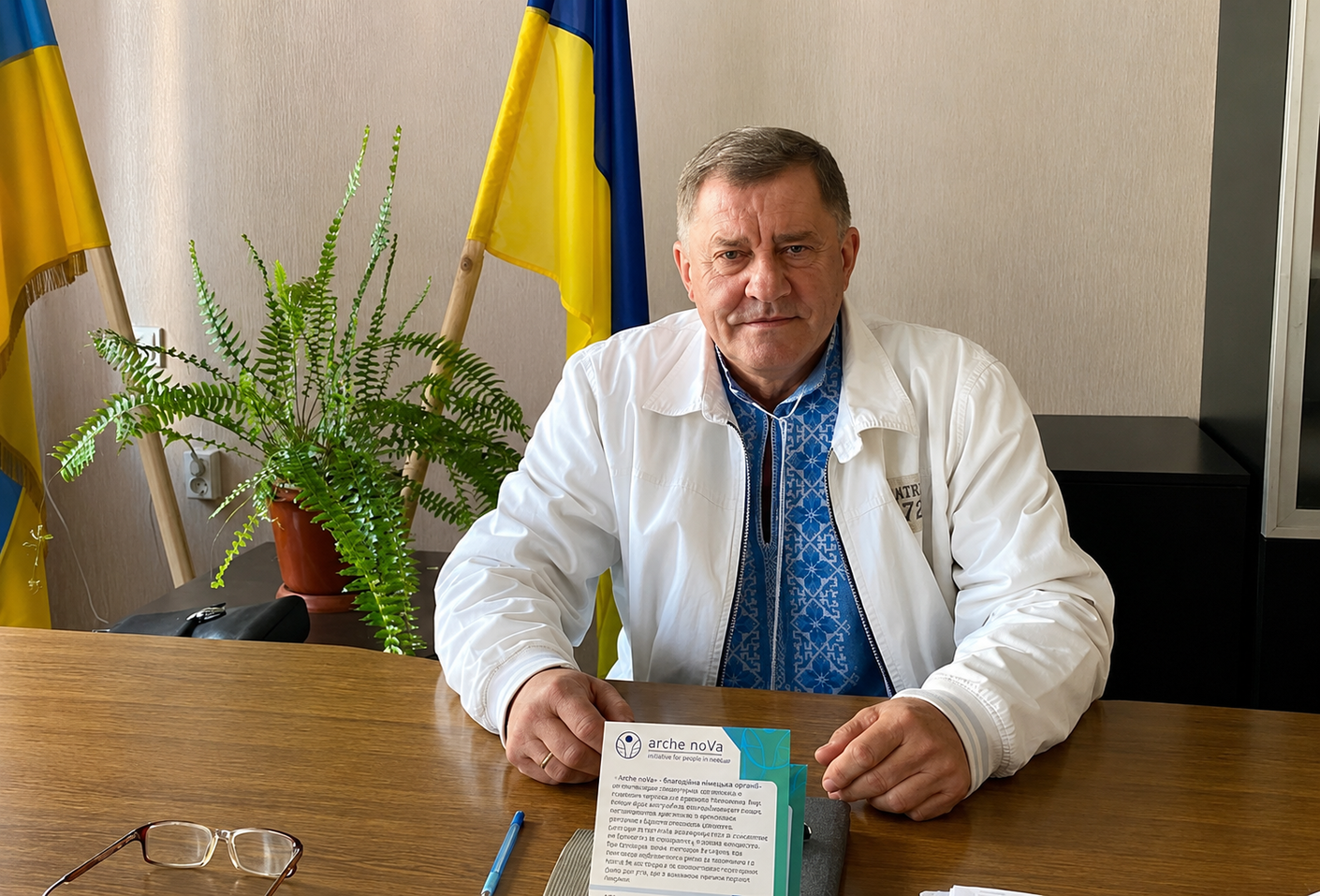
Oleksandr Tertyshnyi, Head of the Borova Military Administration in Kharkiv region, in his office, arranged in the Borova cultural centre in May 2023. In early December of that same year, a russian drone crashed through the office window, completely destroying it
‘People want to stay close to home…’
How different is life in the community now compared to what it was like before the full-scale invasion?
To begin with, before the invasion there were about 15,600 residents, and now there are 1,086. So, around 8% of the former population remains. The situation is particularly difficult on the left bank of the Oskil River, where most of our community’s territory is located and around 680 residents remain, 180 of whom are in our administrative centre – Borova. Despite the fact that back in November 2024, we announced a mandatory evacuation from the left bank. Life there is very tough. For example, electricity was last available there on 29 August 2025. Gas supplies were cut off a month later – on 25 September. At that time, we decided to suspend operations at local businesses and evacuate their assets.
What are the living conditions like on the right bank of the Oskil?
Currently, there is electricity and internet in two starosta districts. Therefore, some villages on the right bank have lost up to half of their former residents. The area is constantly bombarded by russian drones, guided bombs, and artillery shells. That is why people are slowly leaving there too.
Where have the residents of Borova community moved to?
Most people have remained in Kharkiv region, with the largest numbers moving to Izium and Kharkiv. According to our register, around 4,000 of our residents are currently living in Kharkiv region. People want to stay close to home, so one of our offices is in Izium, where around 1,700 residents from our community live. The Borova Hospital has also moved to Izium, where residents of Boriva community can receive medical care from their own doctors. Despite the danger, people who continue to live in the community keep coming to Izium to buy goods in shops, collect their pensions, see a doctor, and for other reasons. In Izium, we mourn our fallen soldiers – in Borova community, unfortunately, this is no longer possible.
Do you keep in touch with the people who have left the community? Do you try to bring these people together?
We work constantly to keep people informed. We have our own Telegram group called ‘Like-minded People of Borova community’, with almost 7,000 subscribers. This is our primary source of information. We post updates on the situation in the community there almost every day. When it comes to support, we try to help everyone. We have compiled a register of our residents who are currently in Kharkiv region, and now we know where each of them lives. This helps us with providing humanitarian aid and addressing other issues that our community residents bring to our attention.
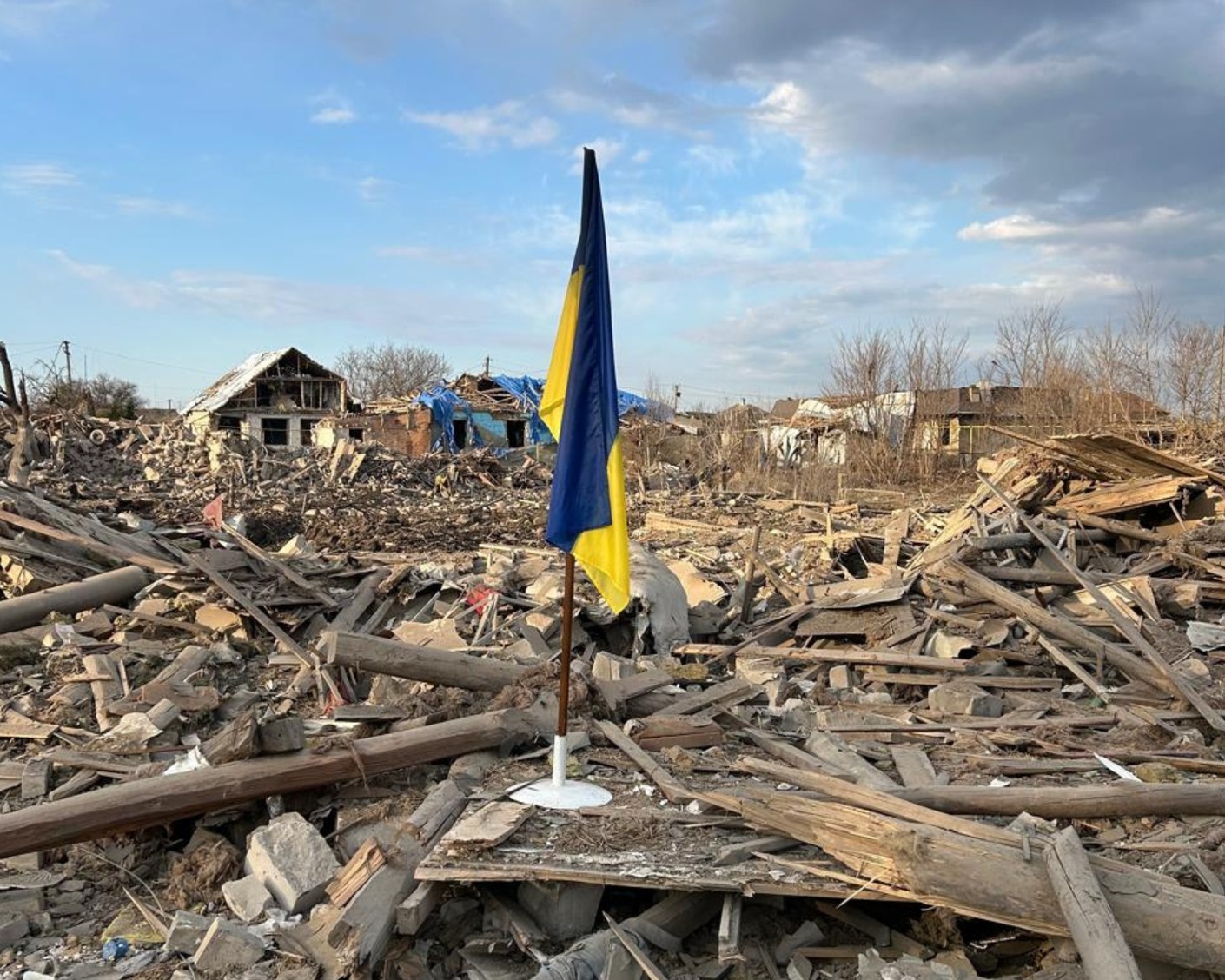
The Ukrainian flag that the owner of a building in Borova has placed on its ruins
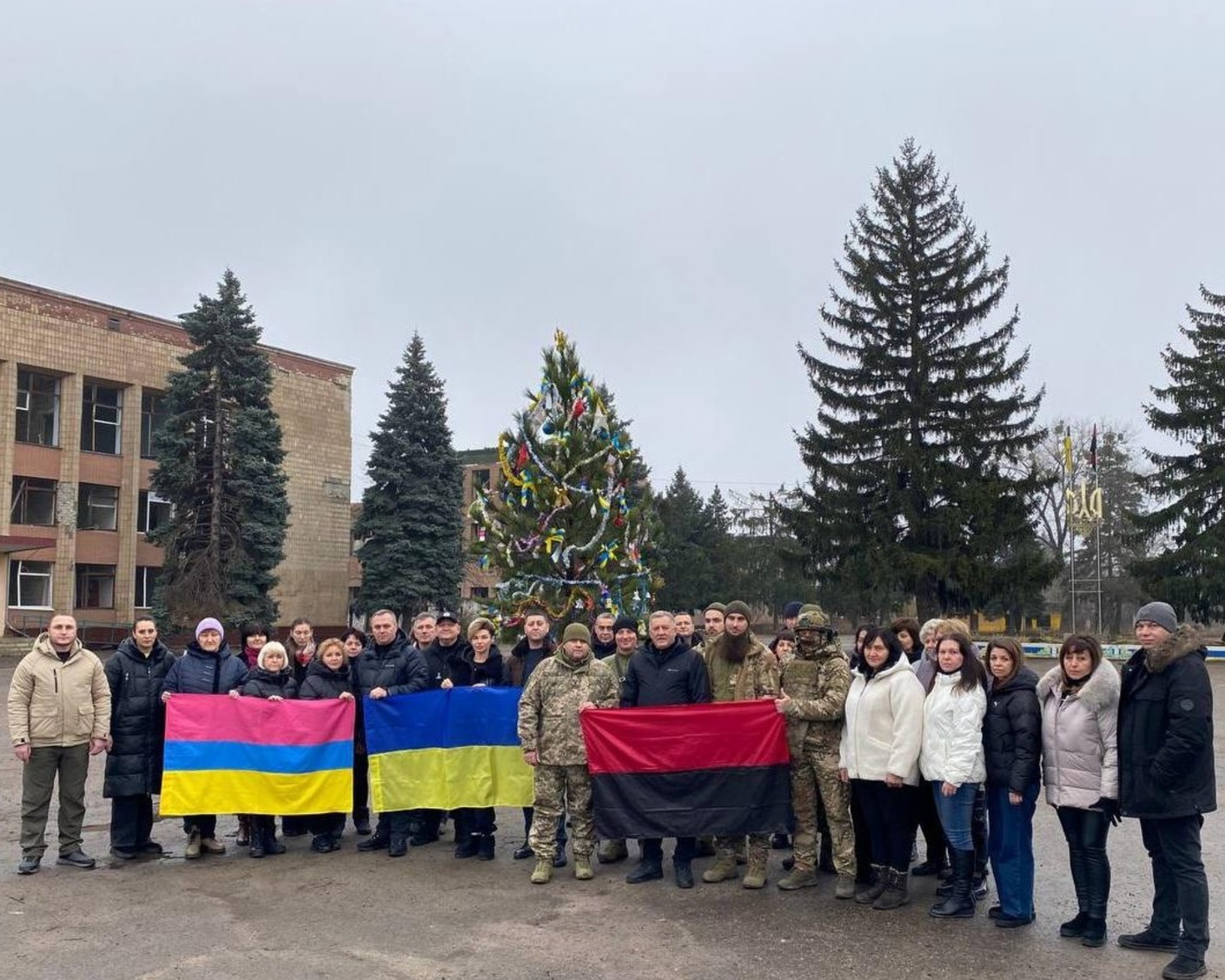
New Year 2024 celebrations in Borova
The Borova schools provide online education for 676 children
What can you say in general about the destruction in Borova community?
Borova itself has been destroyed by about 50%, or perhaps even more. There is extensive damage in the villages located closer to the front line. Unfortunately, it is currently impossible to estimate the exact scale of the destruction, as hostilities are ongoing in the community. All educational and cultural institutions, without exception, as well as all administrative and utility buildings, lie in ruins or are severely damaged. The commission of the settlement council on destroyed property is working to review citizens’ applications for compensation for destroyed property. However, due to the security situation, it has recently become impossible for commission members to examine the destroyed houses and flats. The commission is therefore trying to work remotely, although this is extremely difficult.
How do you reach the left bank of the Oskil? Since all the bridges have probably been destroyed.
A crossing has been built over the Oskil River, but, unfortunately, it is regularly shelled. Just a few days ago, enemy drones attacked civilian vehicles on the crossing. So, it is very dangerous to travel there.
You mentioned that the schools in the community have been destroyed, but are they working online? From your perspective as a former school principal and head of the education department, what is the current state of the educational system in Borova community? Please share your views.
Schools and kindergartens are currently operating online. There are 676 children enrolled in schools at the moment. This is roughly half the number who were attending our educational institutions at the start of the war. In total, there are four schools (out of nine) and four kindergartens still operating. We also have a development plan for the education network, but much depends on the course of the hostilities.
Do those whose homes have been destroyed receive housing certificates?
Questions related to the ‘eVidnovlennya’ programme are of critical importance to us, as hundreds of residents in our community have lost their homes. Fortunately, they are eligible to receive certificates from the state to purchase new homes. Some residents have already received these certificates and bought homes, but, unfortunately, many more people do not have this opportunity. This is because they require a decision from our commission, and the commission is unable to examine the damaged property due to constant shelling and hostilities. Besides, our community currently only maintains a register of destroyed property. The register of damaged property is not operational because our community is located in the zone of active hostilities, where shelling and the destruction of housing continue. In total, since the outbreak of the war, we have processed 176 applications and are currently examining another 299 buildings.
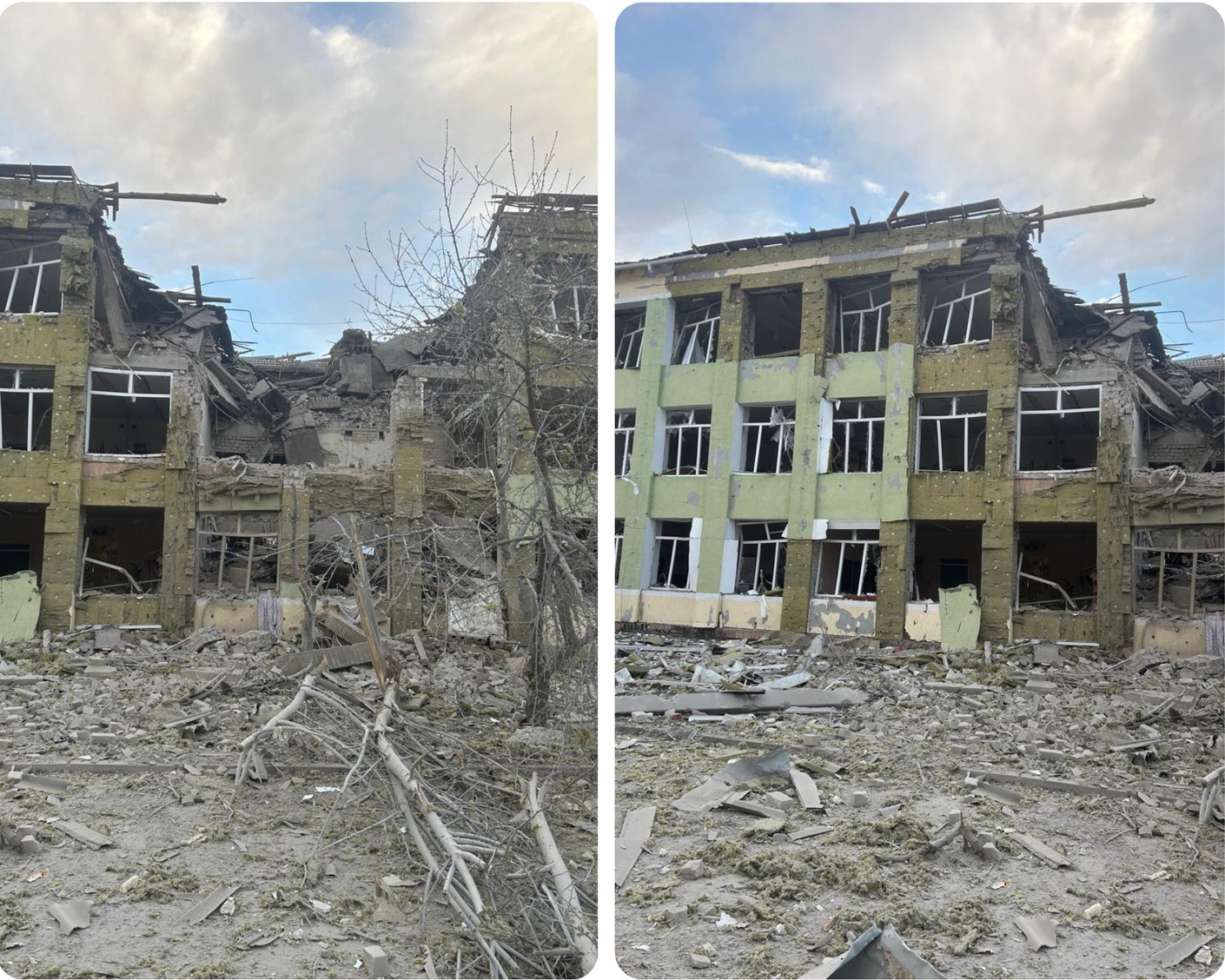
School No 1 in Borova
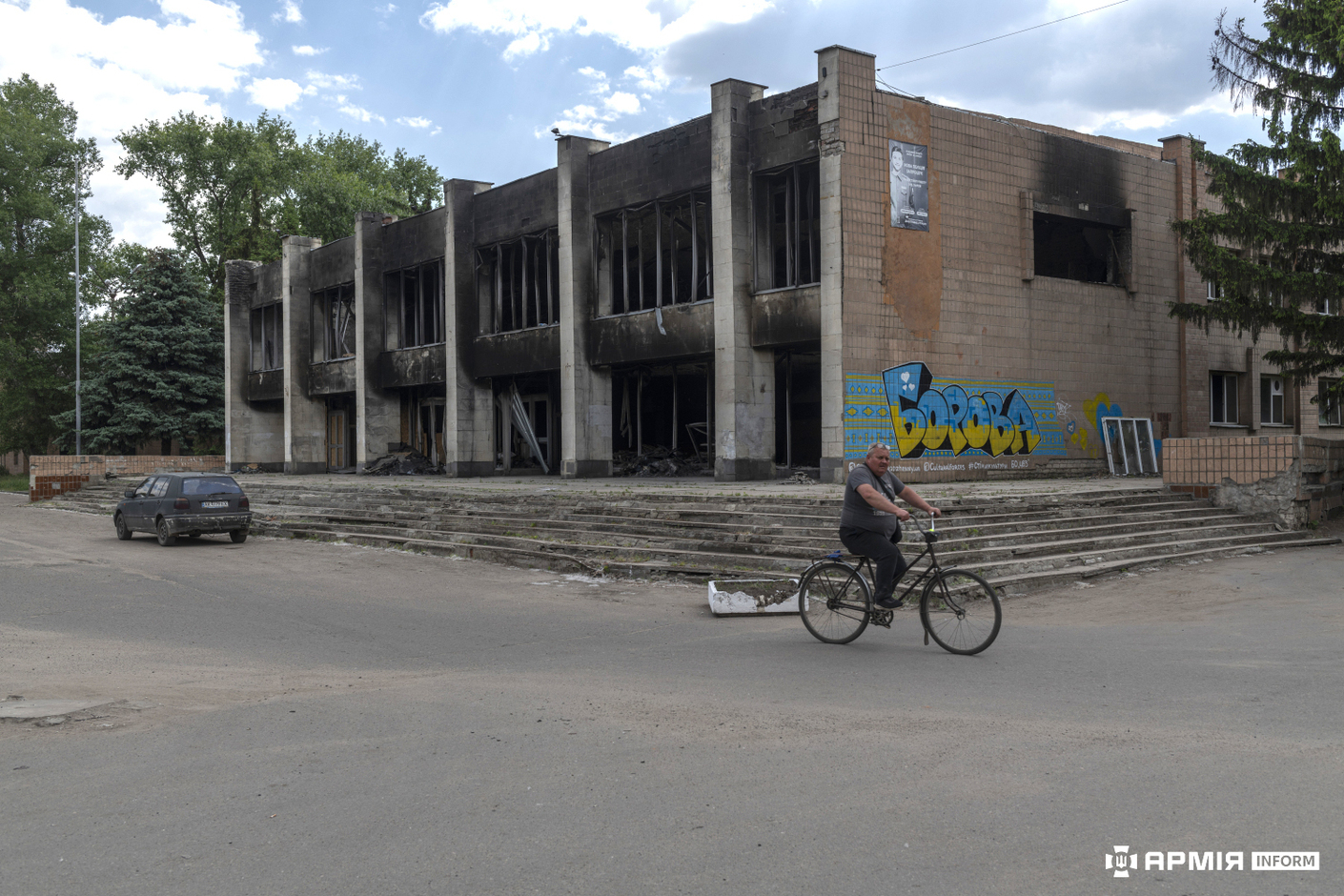
The Children’s and Youth Creative Centre, designed to accommodate 540 children, underwent a major renovation in 2021 due to decentralisation reform
‘We have donated around UAH 90 million to the Armed Forces of Ukraine…’
Borova was under occupation from 13 April to 3 October 2022. What is known about russian crimes committed in the community?
What frustrated people the most during the occupation was that they were in an info vacuum; they had no information about the real situation at the front or in the country, and received no news from their families and loved ones. This took a huge emotional toll. And, of course, the russians behaved in our community like typical invaders. In total, 98 of our residents died during the war – both from torture and from strikes by russian artillery, aircraft, and drones.
Does the settlement council support the Armed Forces of Ukraine, who alone can prevent a second occupation?
Since 2023, we have provided a total aid package to the Armed Forces of Ukraine worth around UAH 90 million. We also use our own budget to pay annual allowances to those who have been called up, the wounded, the families of the fallen, and other groups. We currently have almost 100 veterans on our register. In fact, two of them, who are war invalids, recently received state funding to purchase housing, which they used to buy flats in Kharkiv. And, of course, given the specific nature of our situation, we cooperate extensively with the military.
What are the biggest challenges you currently face as Head of the Military Administration?
The issue of providing humanitarian aid is pressing, as all residents of our community – both those who have remained in the community and those who have been evacuated – are living in extremely difficult conditions and need assistance. Until January 2026, we regularly provided them with humanitarian aid, including both food and hygiene products. We even delivered it to those who remained on the left bank of the Oskil River. But recently, due to constant shelling and the danger it poses, we have been unable to do this on a regular basis. However, we are still delivering humanitarian aid to the villages on the right bank. We constantly work with charitable foundations and international organisations on this. Thanks to them, we are also able to distribute humanitarian aid to residents of our community who live in frontline localities in Kharkiv region, including Izium and Kharkiv.
What is your attitude to the idea behind the ‘Shoulder-to-Shoulder: Cohesive Communities’ Project, under which communities on the front line or on the border with russia are to become, in practical terms, strongholds that the whole of Ukraine must support?
Very positively, therefore we are actively involved in this Project. Last year, we signed memoranda with the Zhashkiv City Council in Cherkasy region and received UAH 0.5 million from them, which we used to purchase a small tractor and a trailer for it – for community improvement works. However, we do not currently keep this vehicle in the community, as it is very dangerous. We have moved it to Izium, where it is occasionally used. We signed another agreement under the ‘Shoulder-to-Shoulder’ Project with the Yarun Village Council in Zhytomyr region in November 2025. We look forward to fruitful cooperation.
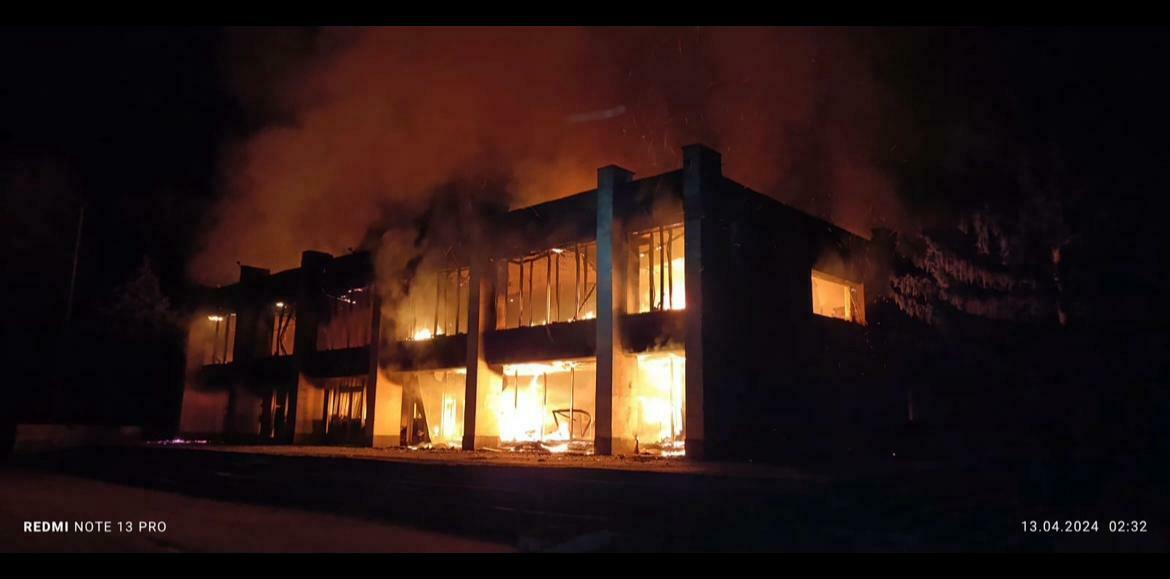
Burning cultural centre in Borova
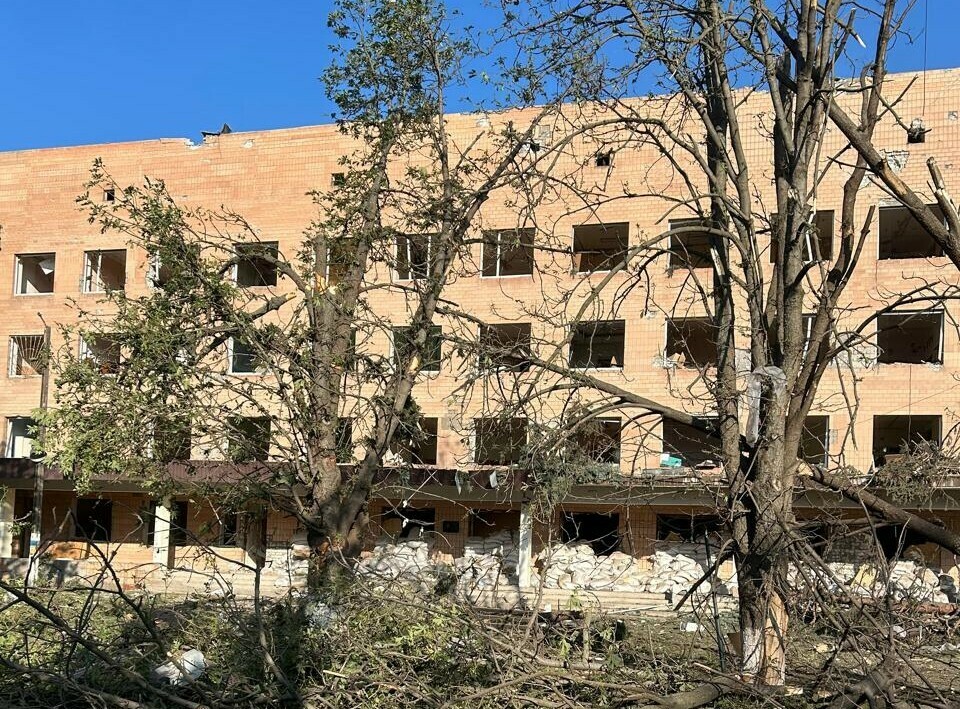
Borova District Hospital, destroyed by the russians
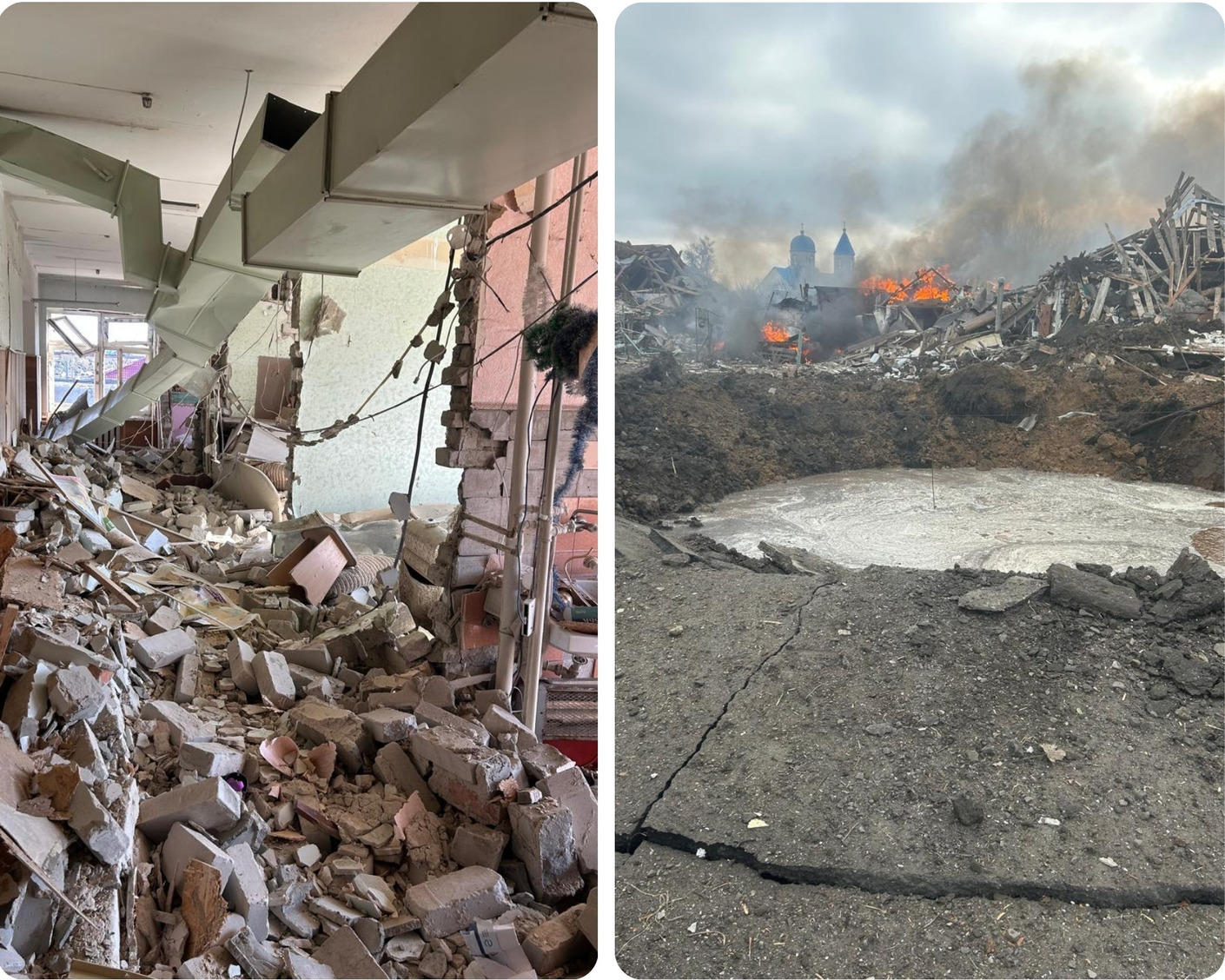
Inside the hospital in Borova (on the left) After a russian air strike on a residential neighbourhood in Borova (on the right)
On the wound, a miraculous rescue, and victory
Borova community is a model of resilience. What is its secret?
The patriotism of our fellow citizens and their professional approach to their duties in extremely dangerous conditions. War is a terrible tragedy, and this war even more so! Yet it has united the Ukrainian nation more strongly than ever before. Today there is no ‘your’ or ‘my’ misfortune – there is our common struggle. The pain has become shared, and the goal is one: Victory!
Please share your most vivid memory of the full-scale war. What struck you the most? Perhaps a particular incident or event…
On the morning of 3 October 2022, as soon as our troops had liberated Borova, we went there: me, my deputy, the secretary of the settlement council… Just imagine, all over the settlement, on poles, on trees, on fences, there were Ukrainian flags hanging, or things painted in yellow and blue. The russians’ footprints had not yet faded, and people were already displaying Ukrainian symbols! Overall, the war has clearly shown who is who. I was struck by the courage of our utility workers and power engineers, who carried on working under shelling. I witnessed a cluster munition strike, which wounded three of our rescue workers. I was standing about forty metres away from them, but fortunately, I was not hit. However, on 6 October 2025, I was less fortunate. One russian drone missed our vehicle, striking about ten metres away from it, whilst another hit just four metres away. I sustained shrapnel wounds to my legs then.
Have you witnessed any miracles during the full-scale war?
When death is all around you, the fact that you are alive is already a miracle. And yet, sometimes incredible things do happen. For instance, last year a russian guided aerial bomb – a KAB – struck a two-storey block of flats with 16 flats in Borova. The central entrance was completely destroyed. And in that entrance, on the second floor, an elderly woman was asleep on the sofa at the moment of the strike. So, she was flung along with that sofa three floors down and fell with it into the basement, yet she remained unharmed. Well, at least she had no broken bones. Rescuers heard her voice from under the rubble and rescued her. A miracle, isn’t it? But how wonderful it would be if there were no need for such miracles at all! If only there were no terrible war, if only we could live as before, and our only worries were not bomb craters but potholes in the roads.
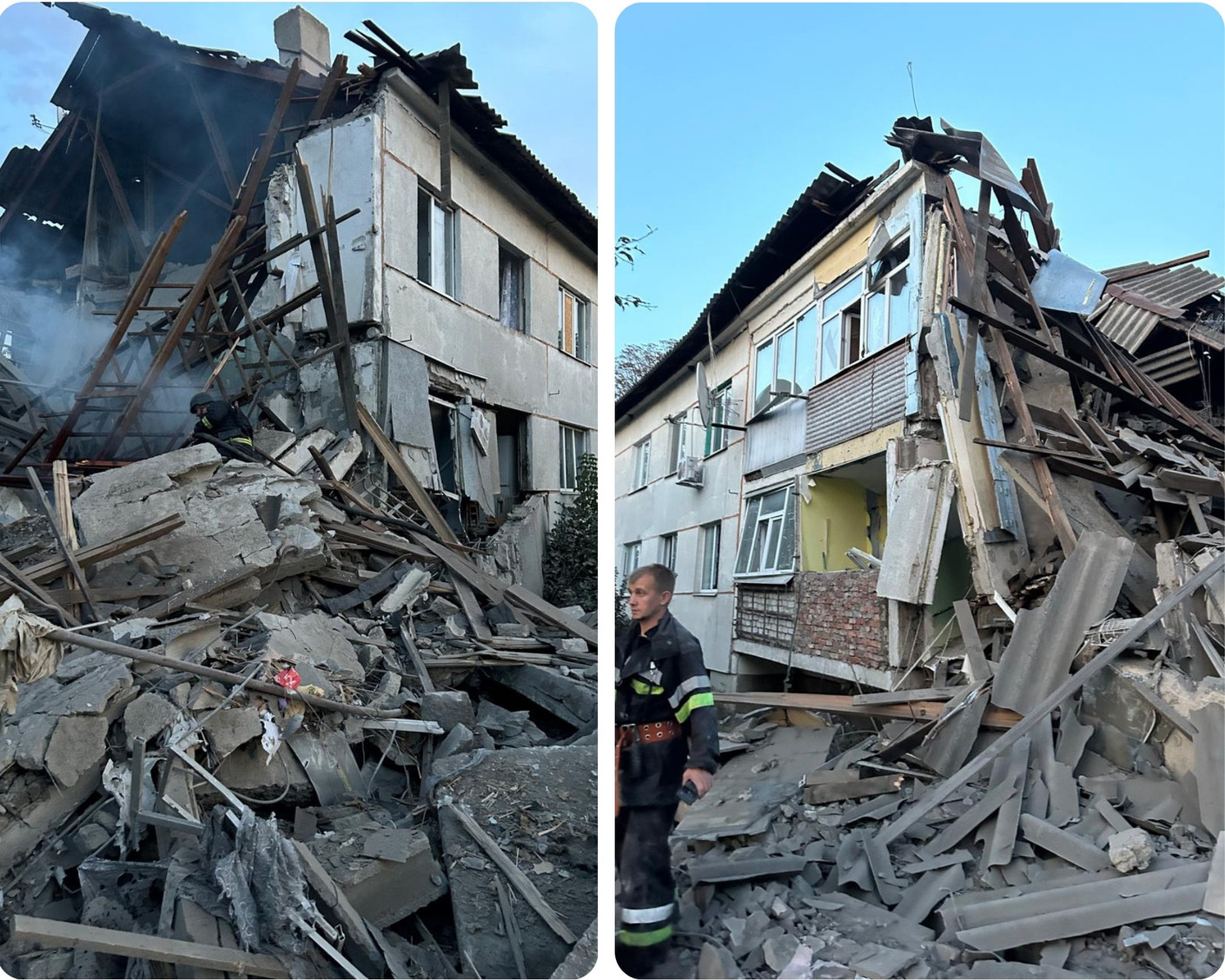
16-flat apartment block in Borova, in the basement of which rescue workers found an unharmed elderly woman who had fallen there from the second floor along with a sofa
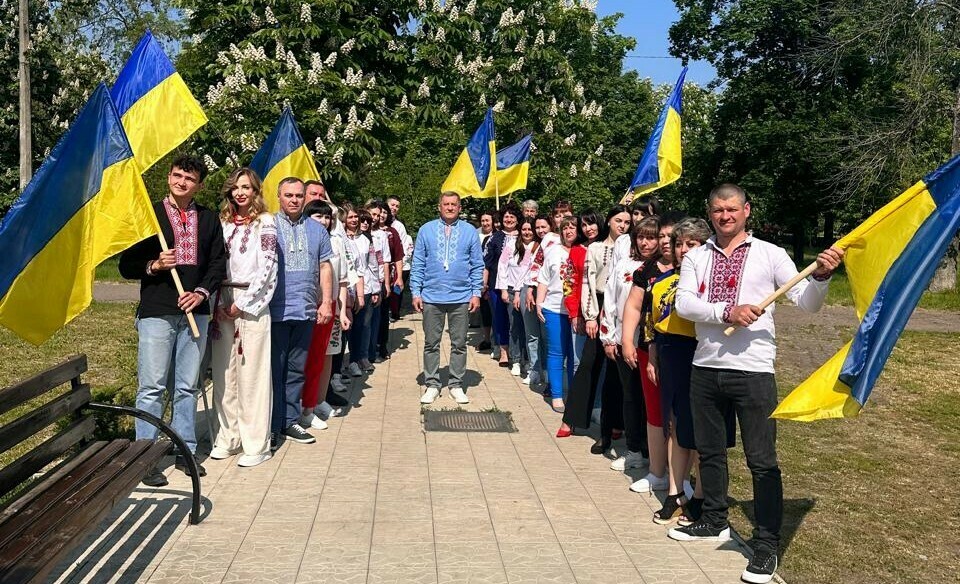
The first Vyshyvanka Day following the de-occupation of Borova. May 2023
16 September 2026
Енергоменеджмент громади: де система найчастіше дає збій і як це перевірити
Енергоменеджмент громади: де система найчастіше...
Змоделюємо дві громади. Перша — велика міська: 96 400 мешканців, 126 громадських будівель, із яких 112 уже охоплені...
15 September 2026
State-of-the-art regional policy instruments
State-of-the-art regional policy instruments
This article delves into tested practices and solutions to operationalise decentralised regional development. It...
15 September 2026
Профорієнтація обʼєднує. Як евакуйована...
Громада перебуває в зоні активних бойових дій, її жителі повність евакуйовані та розпорошені Україною та світом, а...
15 September 2026
Відкликання депутатів місцевих рад: Комітет підтримав зміни до Виборчого кодексу
Відкликання депутатів місцевих рад: Комітет...
Комітет Верховної Ради з питань організації державної влади, місцевого самоврядування, регіонального розвитку та...