Aesthetics as a strategy: How vocational college in Ivano-Frankivsk is breaking down stereotypes and creating a space for the future through cooperation
‘I’ve changed my mind, I’m not going to study here!’ – these words, spoken hysterically, were what Nataliia Kohuch, Director of the Ivano-Frankivsk Centre for Vocational and Technical Education No. 1, heard from a prospective student right in the hall of the educational institution a few years ago.
The girl had been looking at beautiful photos of modern workshops on social media, but the first thing she saw in person was an old, shabby hall. This story was a defining moment for the director of the centre: she realised that without a modern space, even the best equipment would not be enough to save the prestige of vocational education. Everything has changed since then.
Nowadays, apart from modern workshops, there is a career guidance hub here, which has become not just a venue for masterclasses, but a symbol of a new approach to learning.
‘The idea behind this hub is to help students in Grades 7–9 explore different professions in a practical setting. The hub focuses on guiding teenagers towards careers in light industry and the service sector. I am delighted that here in Ivano-Frankivsk there are such committed business partners who not only organise tours for schoolchildren, but also help to develop vocational education by holding masterclasses and other events at the hub. Only cooperation between the education sector, business and the authorities will help create the kind of career guidance system that our young people so desperately need today. Everything is about helping them see their career and life prospects in their own communities and in their own country,’ says Valentyna Poltorak, DECIDE Project Manager.
From an outdated computer lab to a design hub
Just a year ago, the space that is now the hub was an ordinary computer lab.
‘The equipment there was so old that some students were younger than those computers. So, when there was an opportunity to take part in DECIDE: VET project, we took it straight away. We decided to relocate and modernise the computer lab, and set up a careers guidance hub in its place. Our college has long had a system where teachers and trainers are assigned to specific schools to provide career guidance to students, telling them about our college and conducting tours. But the hub takes career guidance to a whole new level,’ says Nataliia Kohuch.
The hub covers an area of almost 100 square metres, but the project includes much more: the entrance area, the hall, the stairwell, and the toilets. It was a conscious strategy to create a barrier-free and aesthetically pleasing route from the door to the learning space.
‘We realised that aesthetics mean a lot to our students. Our professions – hairdresser, make-up specialist, tailor – are all about a sense of taste. And to have a sense of taste, one needs to be surrounded by beauty,’ says Nataliia Kohuch.
The total budget for the project was more than UAH 4.3 million, of which UAH 497,000 was co-financing from the Centre for Vocational and Technical Education, with the remainder coming from DECIDE.
Cooperation as the foundation for development
One of the main challenges was the renovation of the entrance hall. When the initial funds for the hub ran out, the entrance hall was left in a terrible condition. For the director, this was a matter of principle: ‘Without the entrance hall, the whole idea would have been undermined.’ To overcome this challenge, the institution decided to seek cooperation.
‘We cooperated with neighbouring vocational colleges. Nearby, there is College No. 21, which trains welders. We bought them some metal, and they welded the frames for the sofas for us. We then bought the fabric ourselves and made the cushions – it cost five times less than buying ready-made furniture. A third college, which specialises in woodwork, made the wooden wall decorations for us. We simply bought the materials, and our colleagues helped with the work. We are sincerely grateful for their help and are convinced that this sort of cooperation should be commonplace, everywhere,’ says the director.
Such a “trust-based economy” has resulted in the saving of hundreds of thousands of hryvnias and the creation of a modern space. This sends a powerful message to other communities: not everything is solved by direct subsidies alone; often, the key to success lies in cooperation between educational institutions.
‘Cooperation between vocational colleges is a big, underused resource. Instead of looking for expensive specialists from other places, why not help each other on a “quid pro quo” basis? For example, students from the construction college could undertake internships by renovating our student dormitory, and in return we would sew high-quality work uniforms for them. This is an ideal model: the institutions save money, and the students gain real-world experience on actual sites,’ explains Nataliia Kohuch.
A guide around the hub: a space to explore different professions
To ensure that career guidance does not turn into a boring lecture, the hub has been divided into themed stations, or “locations”. Each of these is a mini-model of a real workplace:
- Administrator’s station. Everything here looks just like in a modern hotel or the office of a large company: a stylish reception desk and a full range of office equipment, from computers and printers to a plotter, a laminator, and a binding machine. In this station, schoolchildren and students can practise communicating with clients.
- Training station. A third of the hub is taken up by space for workshops and conferences. It is equipped with chairs, a sound system, two screens (a projector screen and a TV screen) and a whiteboard for brainstorming.
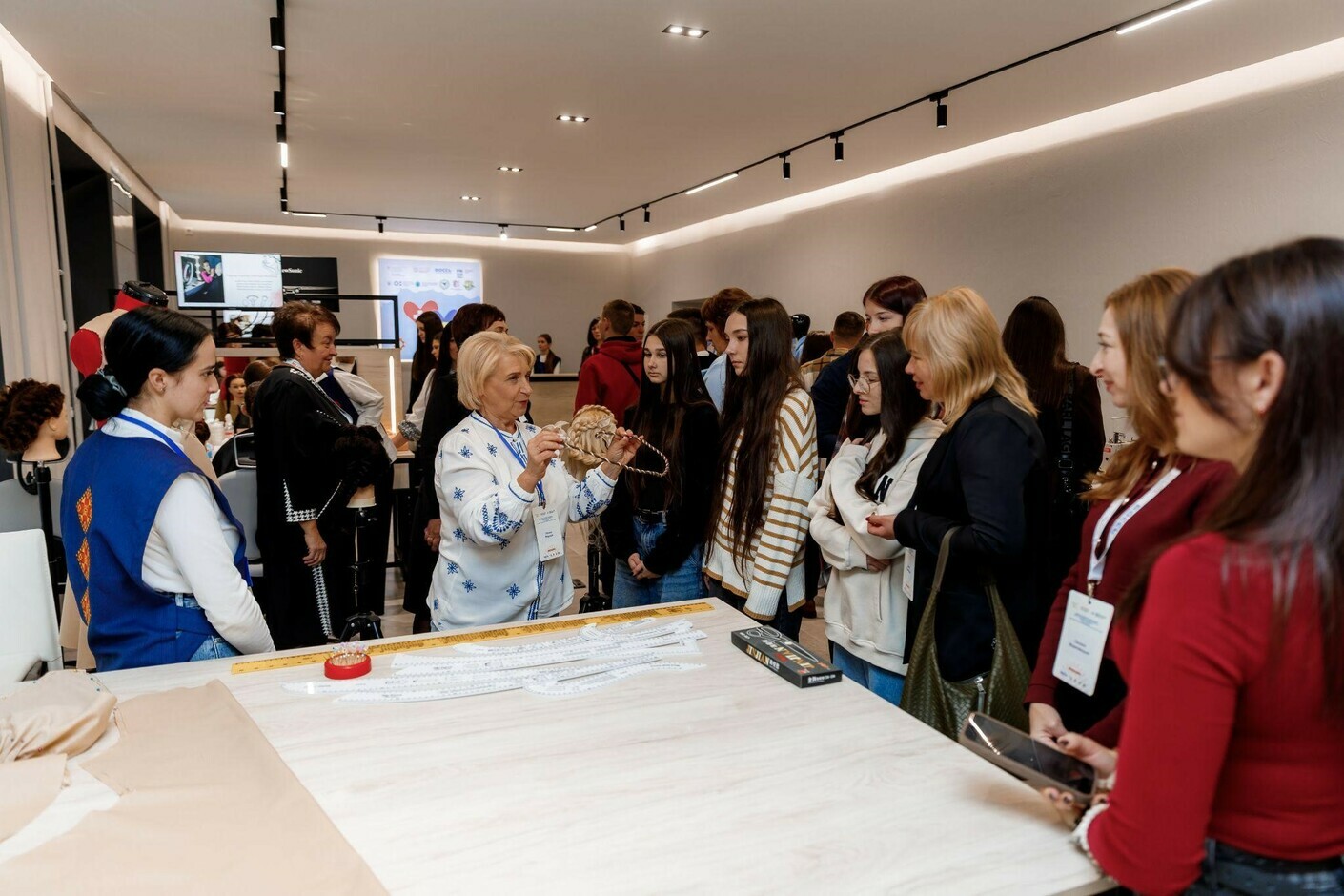
- Tailoring station: from sketch to the catwalk. Part of the hub is dedicated to the art of making clothes. There is an exhibition of clothing collections on mannequins, which are regularly updated.
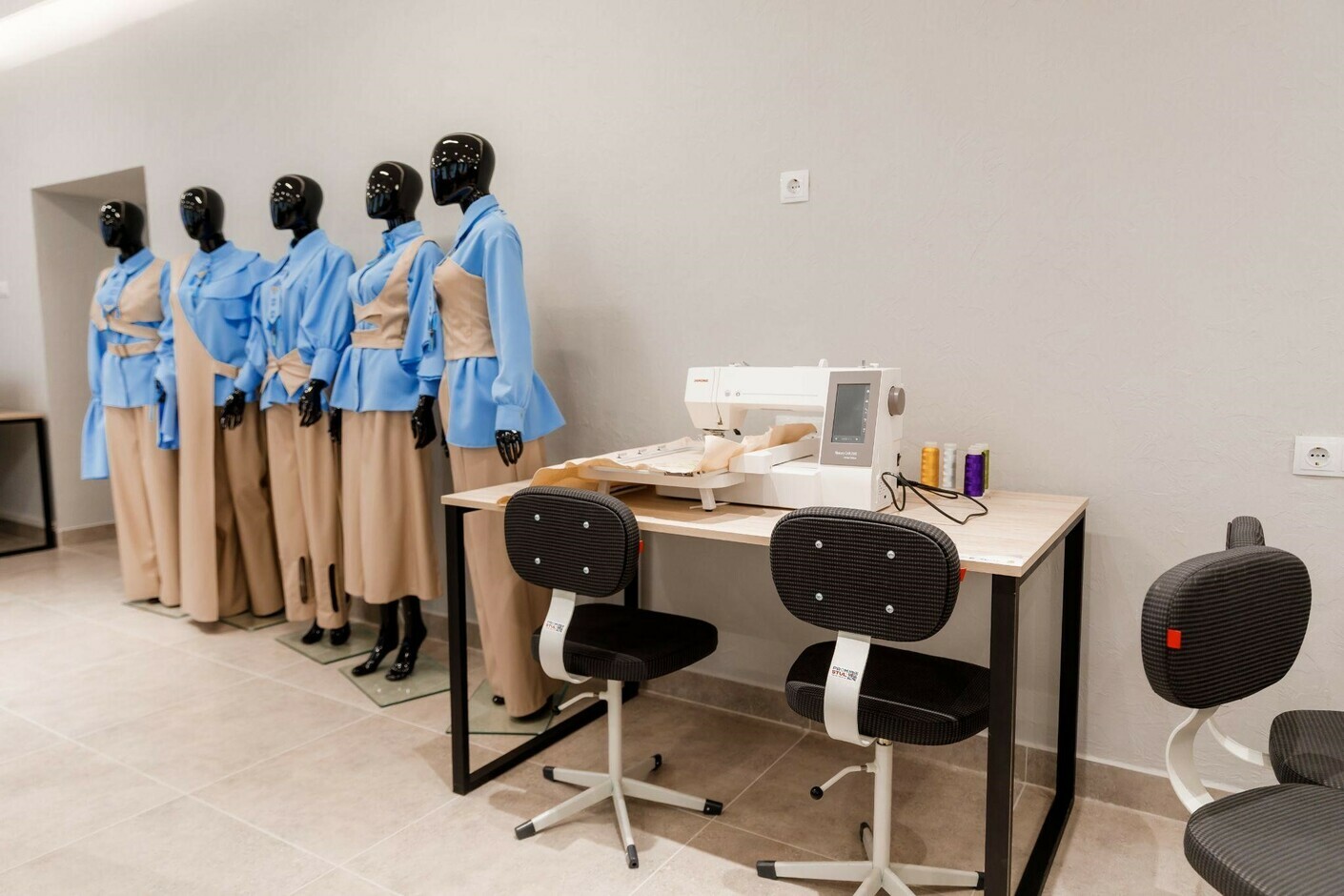
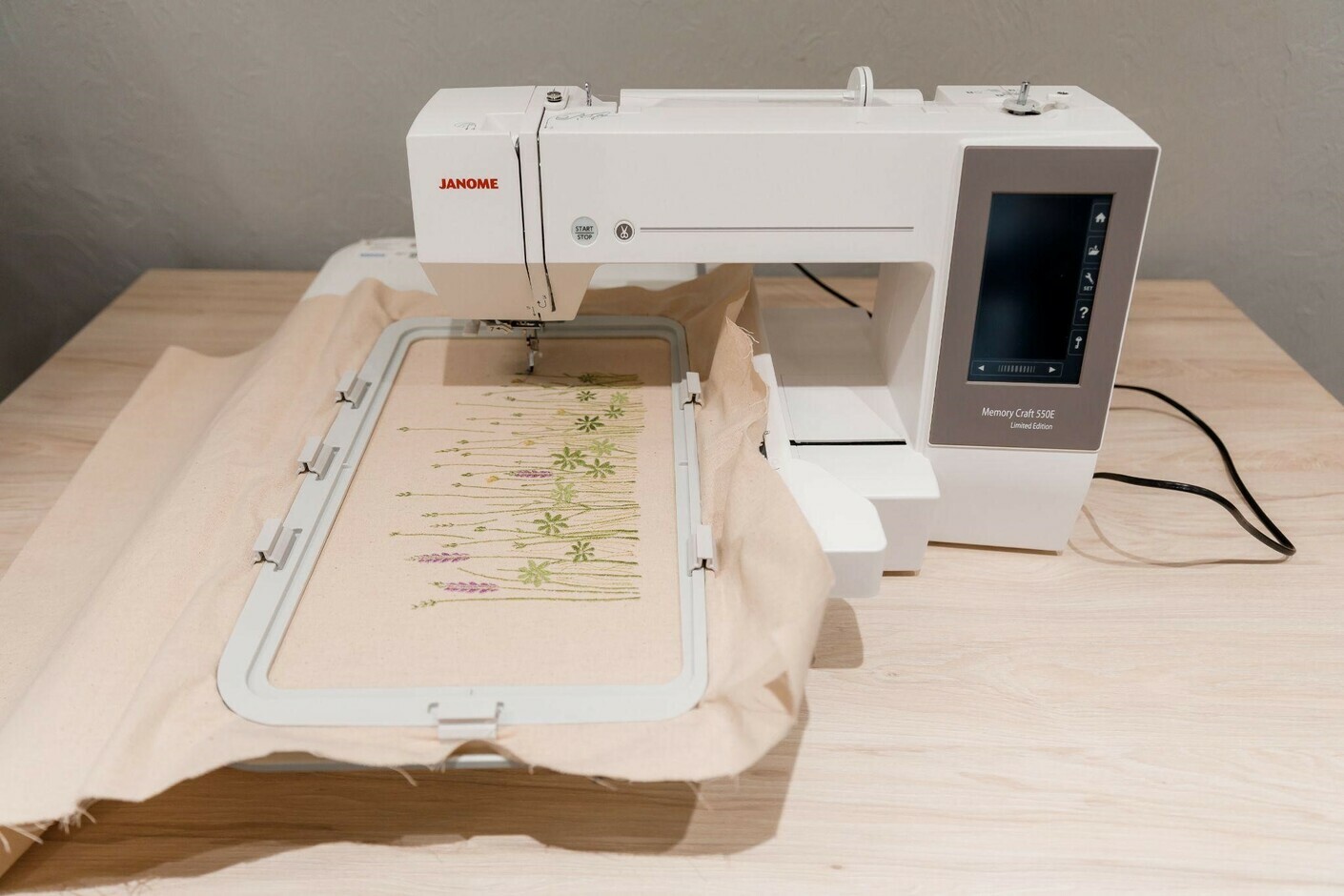
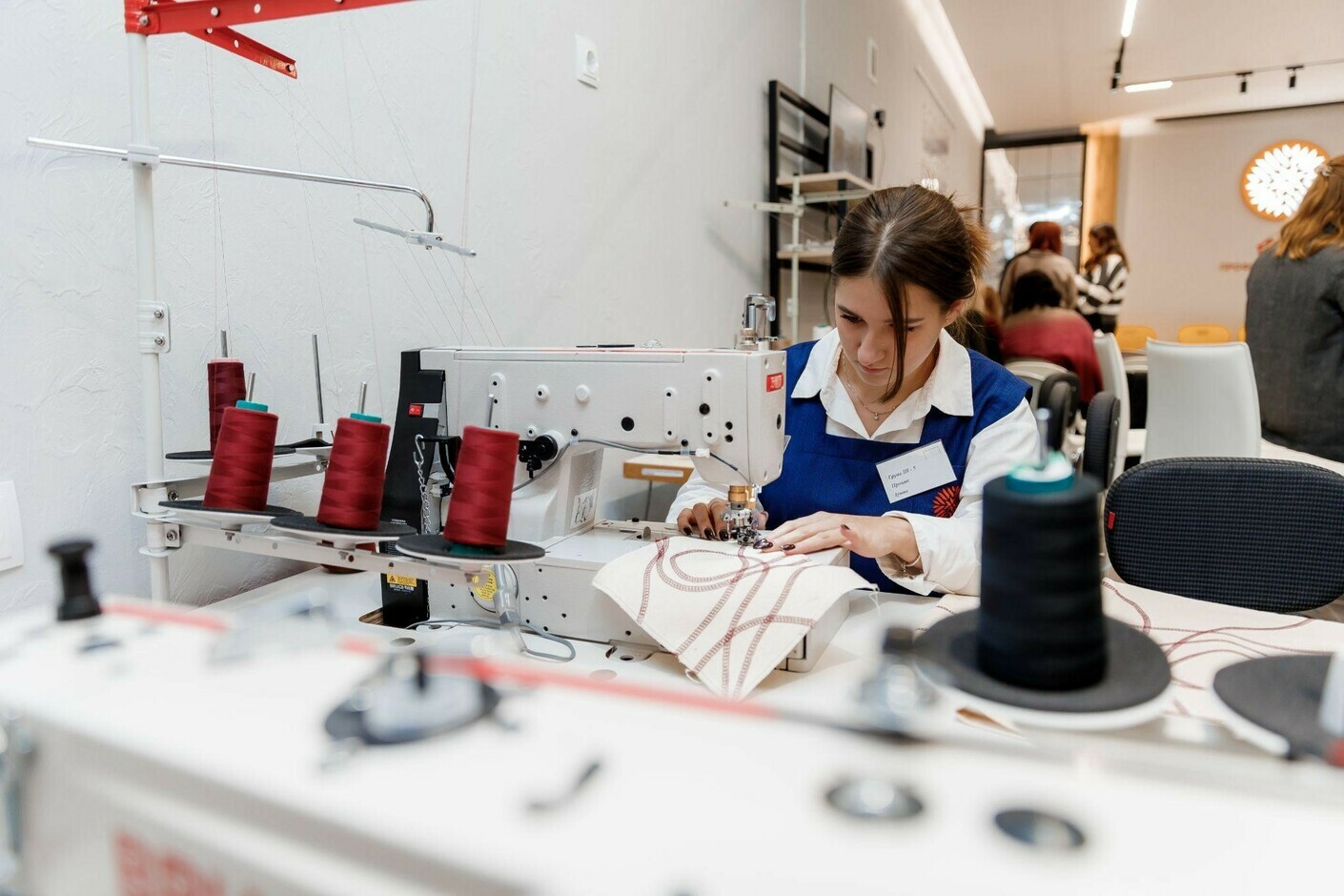
The workstations are professionally equipped: from embroidery machines to specialised machinery capable of making complex stitches. A separate workstation with a large cutting table has been provided for trainee tailors and cutters. Nearby, on a media stand, videos about the intricacies of the profession and interviews with successful graduates are constantly broadcast so that prospective students can see that these professions have real-life applic.
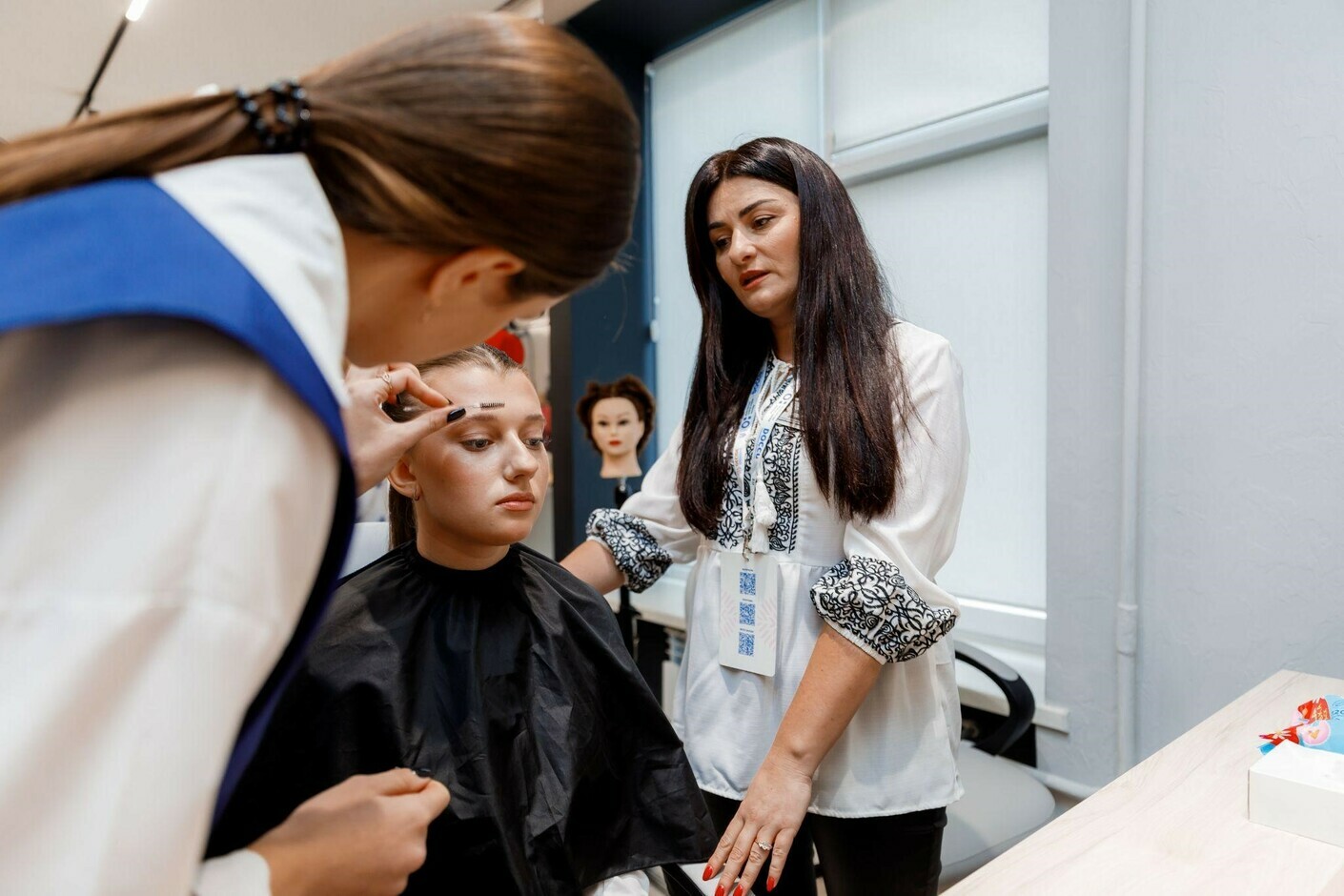
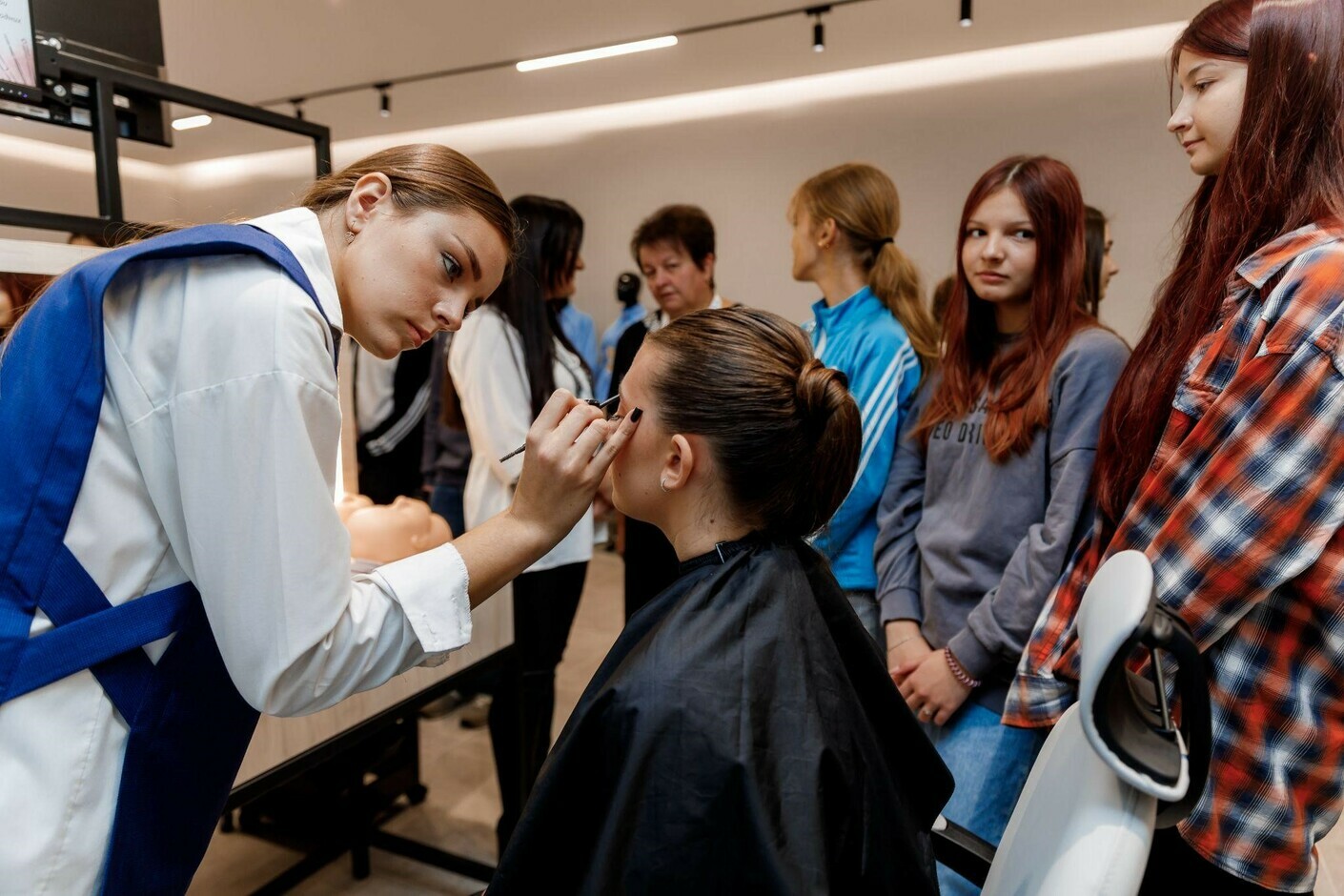
- The beauty station is the most popular among the young visitors. It offers professional workstations for make-up specialists and hairdressers, equipped with all the necessary tools. A special feature of the station is the training mannequins, on which visitors to the hub can try their hand at doing hair or make-up themselves during masterclasses.
- Barrier-free access and the aesthetics of the entrance hall. The description of the hub would be incomplete without mentioning the entrance hall. It is a modern area. The stairwell is equipped with a lift for people with disabilities, and the toilets are fully adapted to the needs of people with reduced mobility.
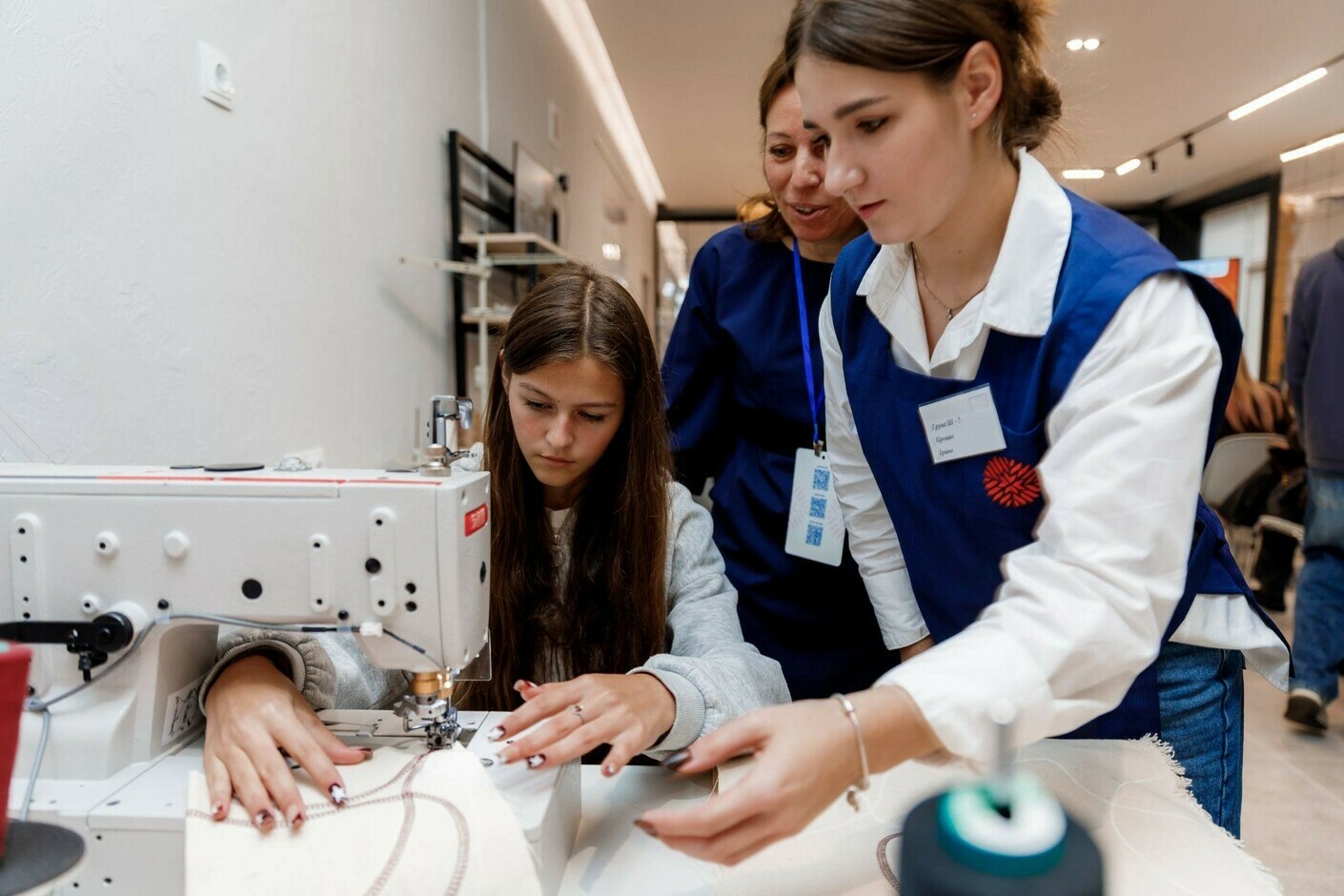
‘For the students and instructors in charge of the premises, we have designed uniforms – stylish vests adorned with authentic Hutsul embroidery and DECIDE logo. This is not just a beautiful piece of clothing: such attire disciplines students and helps visitors to the hub immediately understand who exactly they can turn to for help,’ explains the director of the vocational college.
The hub is almost never empty. Veronika Sulim, a career guidance specialist, explains that meetings with schoolchildren are organised here every week.
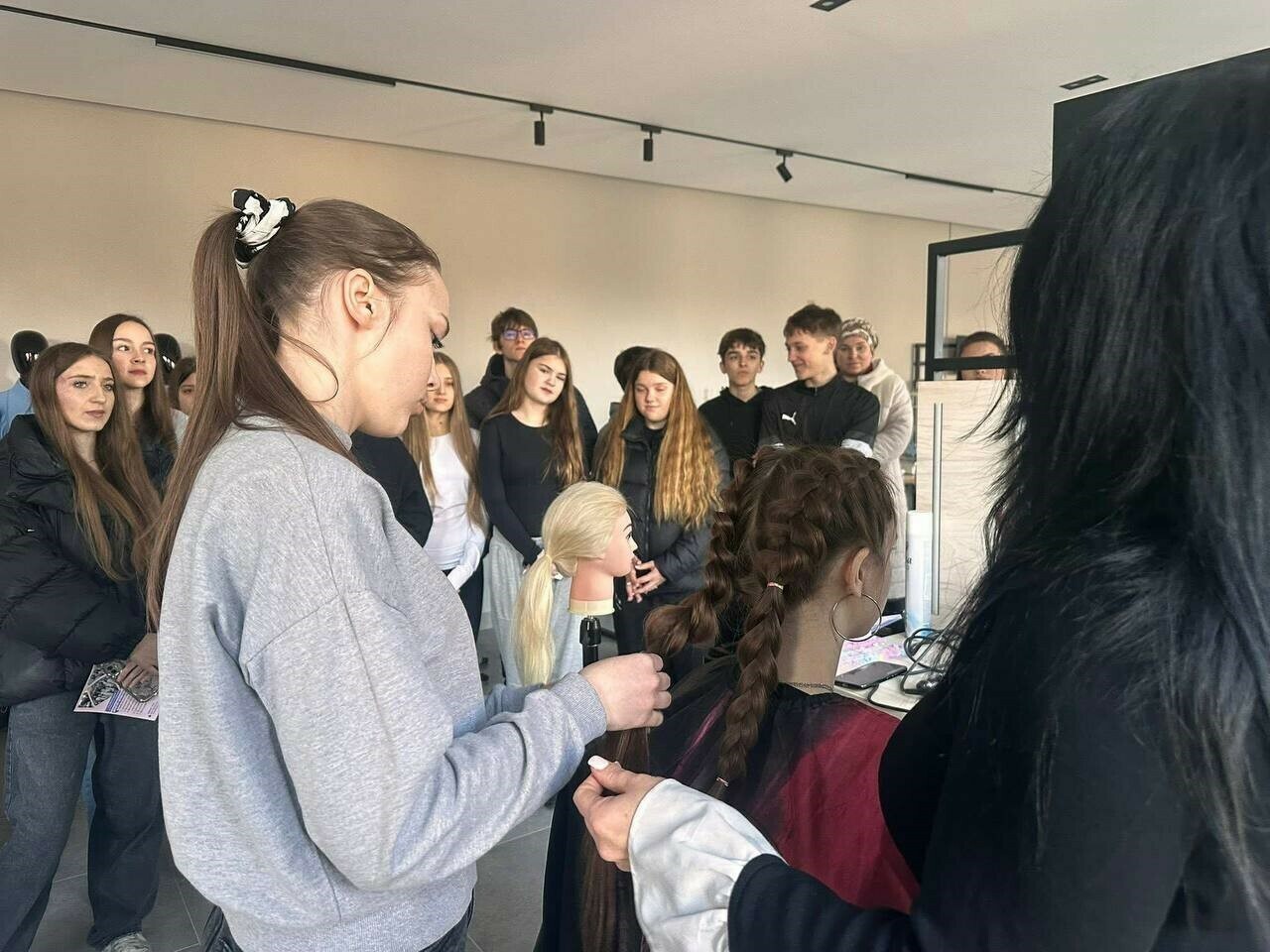
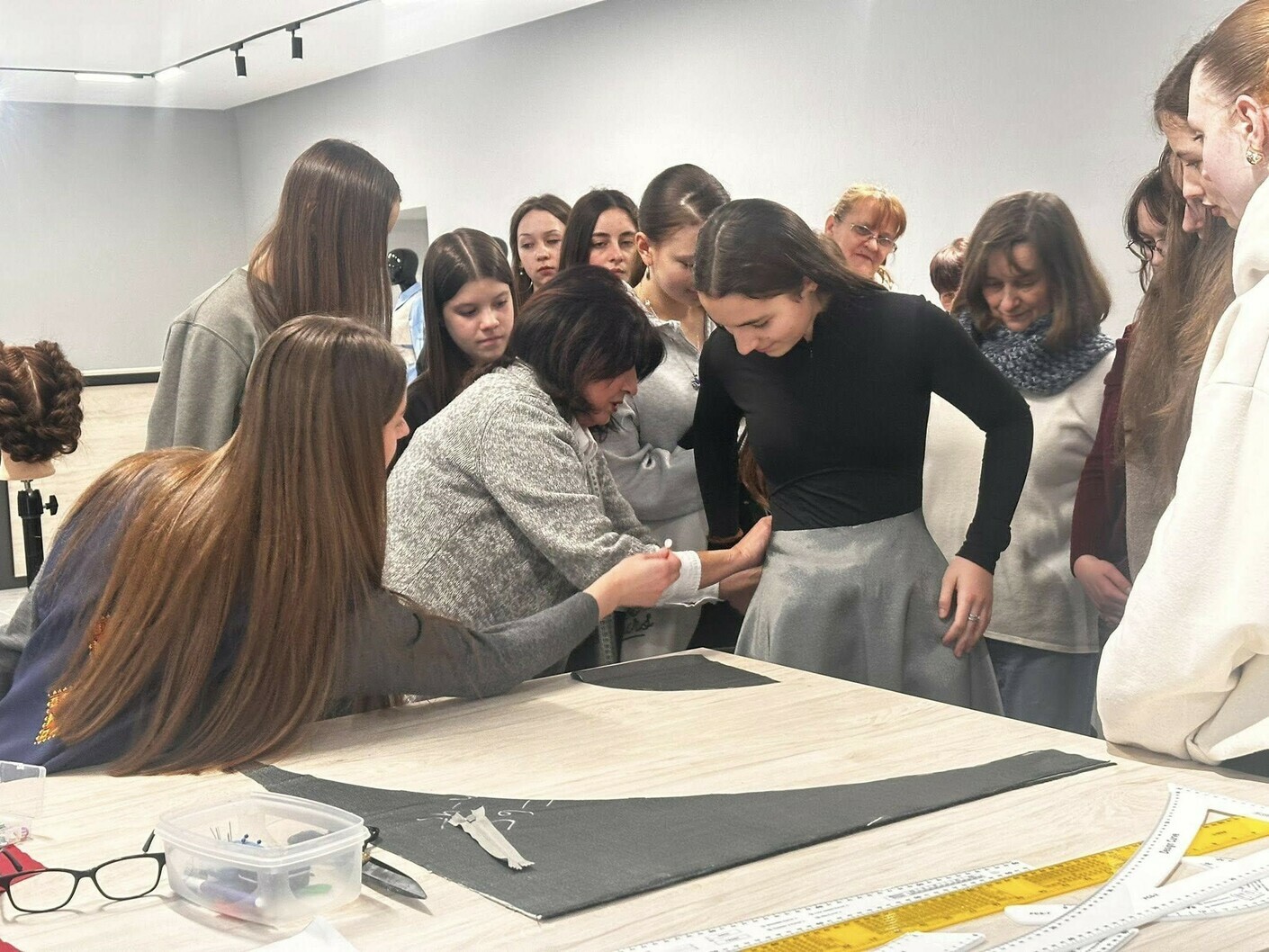
‘The main feature is active learning. Teenagers do not just listen to lectures – they work with their hands. In the hairdressing station, ninth-graders learn to plait hair on mannequins or apply everyday make-up. In the tailoring station, under the guidance of master tailors, the children can cut out their own garments – recently, for example, they sewed skirts together. The schoolgirls were thrilled. Schoolchildren are most receptive to information from their peers. Therefore, we involve our third-year students. When ninth-graders see that a boy or girl, only a few years older than them, has already mastered the technique so skilfully – it builds trust,’ explains Veronika.
The Centre has signed memoranda of cooperation with a number of companies and organisations that are willing to provide students with work experience and internships, as well as to run focus workshops and training sessions at the hub.
‘We invite employers who share career prospects with young people. Children need to see that a profession is not just a skill, but a social ladder,’ adds the expert.
How the interactive route for schoolchildren works
A tour around the vocational college is not just a casual stroll through the corridors, but a carefully planned interactive session that lasts about an hour. During this time, a group of between 15 and 40 schoolchildren (usually one or two classes) goes from a theoretical introduction to a real-life immersion in the profession. The itinerary is structured according to the principle of “from the general to the specific”:
- Start in the conference hall. The tour begins in the hub’s training station. Here, the teenagers watch presentation videos on large screens and are introduced to the philosophy of the institution and the nuances of different professions.
- After this general overview, the specialists introduce the hub’s stations. Since hardly anyone wants to be both a tailor and a hairdresser at the same time, the children are given a choice. They form groups based on their interests and go to practical workshops, where they can try out the tools straight away.
- A tour around the college. A careers guidance specialist shows the group round all the workshops and classrooms. An “open-door” approach is applied here: any group can drop in on a live lesson.
According to the director, the students at the Centre are already used to visitors, so they continue working when another class enters the workshop. This creates a unique “learning behind glass” effect – prospective students see the real process, without exaggeration or staging.
‘We hide nothing. Want to go into a classroom? Please do. Want to go into the workshop? Feel free. A child needs to see behind the scenes at a college, to feel the rhythm of the work and the atmosphere. Only then can they understand whether or not it is right for them,’ explains Nataliia Kohuch, talking about the Centre’s strategy of openness.
A profession is like an insurance policy
The war has changed people’s attitude towards blue-collar jobs. Nataliia Kohuch remembers the first days of the full-scale invasion and her own thoughts about what she would do as a chemistry teacher and education manager abroad.
‘Most likely, I would be putting goods on the shelves at “Biedronka” or doing cleaning. Because there are plenty of Poles with skills like mine there. But our graduates – tailors or hairdressers – will find work in any country in the world and be able to work in their chosen profession. Our diplomas are recognised in both the US and Canada. Having a blue-collar profession means having a kind of permanent insurance policy,’ notes the director.
Today, the educational institution is a monopoly in the region in certain fields. For example, only a few tailors are trained for such a large region, despite the huge demand from relocated businesses – for instance, from Kharkiv, where the field is very popular – and other industrial centres.
Moreover, thanks to the support of the Department of Education of Ivano-Frankivsk, 2026 was declared the Year of Career Guidance in the city’s vocational colleges. This helps to break down stereotypes:
‘Schools often try to keep children in Grades 10-11, undermining us. But when teachers do bring their students to us, it really breaks the mould. I often stand there in jeans and trainers, and the children, not recognising me as the director, whisper, “We were told it was a bit of a stick-in-the-past place here, but actually it’s our school that’s stuck in the past – this place is amazing!” At moments like that, I realise: my goal has been achieved; we have changed their perception,’ says Nataliia Kohuch.
A new focus: veterans and inclusion
The hub plans to expand its target audience to include adults. Special emphasis is placed on veterans and people with disabilities. In particular, the Centre plans to provide career guidance to help revive the shoemaker’s trade, which is losing popularity.
‘Shoe repair stalls and booths are closing down. The workers say, “If we leave, there’ll be no one left to do the work.” We, however, have retained our master craftsman, hold a licence to train people in this profession, and have the necessary equipment. Apart from being an unfilled niche in high demand, this is an ideal profession for veterans or people with reduced mobility: sedentary work, minimal physical strain, yet huge demand in the market. We are prepared to provide training free of charge, just to give people the chance to integrate into civilian life through a new career,’ reveals Nataliia Kohuch.
The educational institution is also ready to accept students from all over Ukraine, as it has its own student dormitory. This offers opportunities for internally displaced persons who are interested in gaining a new qualification in a safe region.
Currently, 540 students are enrolled at the Ivano-Frankivsk Centre for Vocational and Technical Education No. 1. This represents 80–90% of the total enrolment. The institution aims to achieve 100% enrolment, as was the case before the war. This, they say, is where the career guidance hub is intended to help.
There are currently 10 such hubs in Ukraine, located in vocational colleges, where students can explore different professions, discover what they enjoy and, ultimately, make the right choice. These are located in six regions: Kyiv, Lviv, Chernihiv, Poltava, Odesa, and Ivano-Frankivsk.
A national pilot project to promote career guidance for children and adolescents is currently ongoing, within the framework of which a call for grant applications will be announced to create similar career guidance spaces in educational institutions in the partner communities.
Mariia Buleiko (Markovska)
Tags:
DECIDE: PROFTECH education vocational training college
Область:
Івано-Франківська областьSource:
Проєкт DECIDE
26 June 2026
Продовжується відбір регіональної команди для реалізації проєкту DECIDE у Київській області
Продовжується відбір регіональної команди для...
Запрошуємо долучитися до відбору на позиції: регіонального координатора/координаторки експерта/експертки в...
26 June 2026
Закон про доплати для фахівців міжнародних...
Підписаний Президентом України Закон №4887-IX, який врегульовує питання матеріального стимулювання посадових осіб...
26 June 2026
Ukrainian frontline communities and Polish...
In Gdańsk, during the Ukraine Recovery Conference 2026, a Memorandum of Understanding was signed between the...
25 June 2026
Європейський альянс міст і регіонів закликав посилити роль громад у відновленні України
Європейський альянс міст і регіонів закликав...
Напередодні Конференції з питань відновлення України (Ukraine Recovery Conference 2026) Європейський альянс міст і...